concept lifecycle in category .net
This is an excerpt from Manning's book Entity Framework 4 in Action.
Let’s start our discussion by analyzing the lifecycle of an entity and its several states.
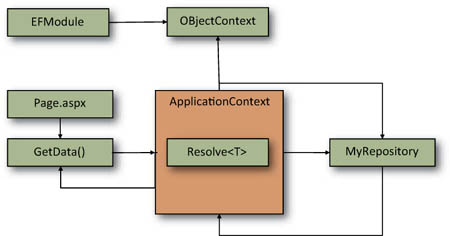

This is an excerpt from Manning's book NHibernate in Action.
In object-modeling terms, this association is a kind of aggregation—a “part of” relationship. Aggregation is a strong form of association: it has additional semantics with regard to the lifecycle of objects. In this case, you have an even stronger form, composition, where the lifecycle of the part is dependent on the lifecycle of the whole.
This leads us to a distinction of central importance in ORM. In .NET, all classes are of equal standing: all objects have their own identity and lifecycle, and all class instances are passed by reference. Only primitive types are passed by value.