concept ObjectContext in category .net
This is an excerpt from Manning's book Entity Framework 4 in Action.
When the objects are ready to be consumed, the context comes into play. By context we mean the lifetime of the communication between the application and Entity Framework. It’s established using a well-known class (ObjectContext, or context), and it’s active as long as the class is referenced in the code or it isn’t disposed of. The context class is used from the beginning because this class creates the entry point for querying the object model.
Public Class Repository(Of T As Class)
  Implements IRepository(Of T)
  Private context As ObjectContext
  Private entitySet As ObjectSet(Of T)

  Public Sub New(ByVal context As ObjectContext)
    If context Is Nothing Then
      Throw New ArgumentNullException("context")
    End If

  Me.context = context
    Me.entitySet = context.CreateObjectSet(Of T)()
  End Sub
End Class
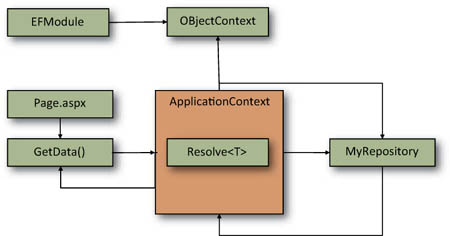
You can use Entity Framework’s features in two different ways: you can use ASP.NET RAD support to directly tie them together; or you can manually manage the ObjectContext lifecycle by writing more code. The first approach has the main advantage of not requiring code, whereas the latter gives you maximum control over what is performed under the hood. Which is the best approach for your application is up to you: typically, the former is indicated in small (or quick-and-dirty) applications, because you can be very productive, whereas the latter is for enterprise applications. We’ll start with the simpler approach and then look at how to directly manage the ObjectContext lifecycle in a typical ASP.NET application.
Before we can move on, it’s useful to note that Entity Framework’s ObjectContext can be instantiated only once per page. If you want to build some kind of layer over Entity Framework (as you did in chapter 14), you’ll have to handle this task manually. If you prefer to let ASP.NET do the magic for you, just sit down and relax: there is a special control, called EntityDataSource that will perform most of the tasks for you. Let’s start by looking at what EntityDataSource can do.