concept persistence in category .net

This is an excerpt from Manning's book Entity Framework 4 in Action.
Maintainability— The fewer lines of code you have, the fewer lines of code you have to maintain. This is particularly true in the long run, when refactoring comes into play and a smaller code base is easier to inspect. Furthermore, the ability of an O/RM tool to bridge the gap between the object and relational models opens interesting scenarios. You can refactor the database structure or model definition without affecting the application code, and only changing the mapping. If you think about the code needed to manually handle persistence and to refactor a database or classes, you’ll immediately understand that maintainability increases if you adopt an O/RM tool.
Earlier we mentioned that if an error occurs during persistence, the transaction rolls back. In that case, AcceptAllChanges isn’t triggered, so if you invoke the SaveChanges method again, the context will try to persist the entities again, the same way it did when the exception occurred because nothing has been touched.
If no error occurs during persistence and the AcceptAllChangesAfterSave value isn’t passed to SaveChanges method, the entities and the entries in the state manager remain untouched so a new call to SaveChanges would trigger persistence again.
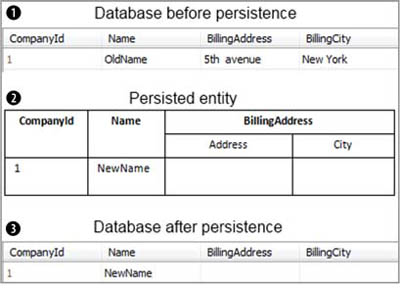
Many things may cause an error during persistence. A string that’s too long, a foreign-key violation, a not-nullable column set to null, a duplicate key, and so on—these are typical reasons for exceptions. Let’s look at how you can handle exceptions in code.

This is an excerpt from Manning's book NHibernate in Action.
Before we can get started with NHibernate, it will be useful for you to understand what persistence is and the various ways it can be implemented using the .NET framework. This chapter will explain why tools like NHibernate are needed.
Persistence is a fundamental concern in application development. If you have some experience in software development, you’ve already dealt with it. Almost all applications require persistent data. You use persistence to allow data to be stored even when the programs that use it aren’t running.