concept storage in category .net
This is an excerpt from Manning's book Entity Framework 4 in Action.
The Object Model and Domain Model patterns are often considered to refer to the same thing. They may initially look exactly the same, because both carry data extracted from storage. But after digging a bit, you’ll find that they have differences: the object model contains only the data, whereas the domain model contains data and exposes behavior.
Listing 5.15. Defining a database foreign key in the storage schema
<EntityContainer ...> <AssociationSet Name="FK_OrderDetail_Order" Association=" OrderITModel.Store.FK_OrderDetail_Order"> <End Role="Order" EntitySet="Order" /> <End Role="OrderDetail" EntitySet="OrderDetail" /> </AssociationSet> </EntityContainer> <Association Name="FK_OrderDetail_Order"> <End Role="Order" Type="OrderITModel.Store.Order" Multiplicity="1"> <OnDelete Action="Cascade" /> </End> <End Role="OrderDetail" Type="OrderITModel.Store.OrderDetail" Multiplicity="*"/> <ReferentialConstraint> <Principal Role="Order"> <PropertyRef Name="OrderId" /> </Principal> <Dependent Role="OrderDetail"> <PropertyRef Name="OrderId" /> </Dependent> </ReferentialConstraint> </Association>
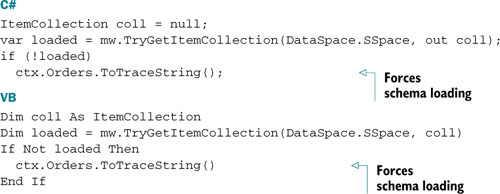
Metadata is an important feature that you must use to be able to modify templates. When you create or modify classes in the designer, only the EDMX file is modified; the template generates the code on demand. It reads the conceptual schema metadata and generates the code based on that data. The same way, when the database DDL is generated, the storage and mapping schema are generated. After that, the storage schema data is used to create the DDL. Everything is metadata-driven.