concept structure in category .net

This is an excerpt from Manning's book IronPython in Action.
Learning a programming language is itself like a work of construction—say, building a house. The basic datatypes, like mortar, bind programs together, and they get everywhere! Next come the larger elements—the bricks and blocks and supporting beams; in Python, these are the functions, classes, and modules that give your program shape and structure. You need to understand these things before moving on to the wiring, the floorboards, and the thousand-and-one other details. (It’s no wonder they call it software architecture!) This order is roughly the one that the tutorial will follow. We won’t get to all the decorations and furnishings; we’ll leave you with plenty more to learn.
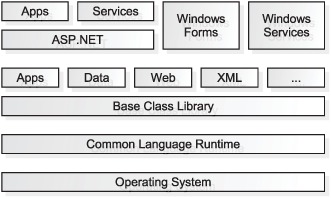
The .NET framework consists of 112 assemblies and 935 namespaces.[1] .NET 3.0, which introduces several important new libraries including the Windows Presentation Foundation, builds on .NET 2.0 rather than replacing it. Namespaces are the libraries that provide classes and other .NET types such as enumerations and structures. With these, you create applications,[2] work with XML and databases, communicate with the computer system, or access external applications such as Word and Excel.