concept benchmark model in category nlp
This is an excerpt from Manning's book Getting Started with Natural Language Processing.
Let’s now go through the steps in this pipeline one by one: we will start with the question of what represents a good dataset for this task, and then we will proceed with building a benchmark machine learning model – something that is relatively straightforward and easy to put together. This benchmark model will set up an important point of comparison for you – any further model with a different set of features or a different algorithm will have to beat the results of the benchmark model, otherwise you will know that the task can be easily solved with the algorithm that you’ve tried first. Finally, we will explore the results and see how the pipeline can be improved to achieve increasingly better results.
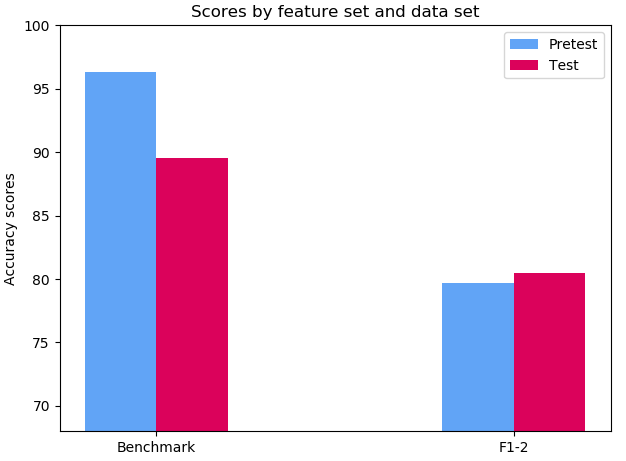
Let’s visualize the accuracy scores as before using bar charts. In particular, let’s compare the performance of the benchmark model from Chapter 5 on the pretest and test sets to your new model that uses two new types of features: average word length (let’s denote this feature type as F1 on the graph) and sentence length (F2). Figure 6.10 visualizes the results:
Figure 6.10 Accuracy scores of a new model relying on average word length (F1) and sentence length (F2) compared to the benchmark model’s performance from Chapter 5