concept gpu in category nlp

This is an excerpt from Manning's book Natural Language Processing in Action: Understanding, analyzing, and generating text with Python.
The sum of the pairwise multiplications of the input vector (X) and the weight vector (W) is exactly the dot product of the two vectors. This is the most basic element of why linear algebra factors so heavily in the development of neural networks. The other side effect of this matrix multiplication structure of a perceptron is that GPUs in modern computers turn out to be super-efficient at implementing neural networks due to their hyper-optimization of linear algebra operations.
The use of GPUs can accelerate your model development and allow you to iterate through your model development more quickly. GPUs are useful, but should you buy one?
The answer in most cases is no. The performance of GPUs is improving so rapidly that a purchased graphic card could quickly get out-of-date. Unless you plan to use your GPU around the clock, you might be better off with renting a GPU via a service such as Amazon Web Services or Google Cloud. The GPU service allows you to switch instance sizes between model training runs. That way, you can scale up or down your GPU size, depending on your needs. These providers also often provide fully configured installations, which can save you time and let you focus on your model development.
We built and maintained our own GPU server to speed some of the model training used in this book, but you should do as we say and not as we do. Selecting components that are compatible with each other and minimizing the data throughput bottlenecks was a challenge. We imitated successful architectures described by others and bought RAM and GPUs before the recent Bitcoin surge and the resulting high performance computing (HPC) component price spike. Keeping all the libraries up-to-date and coordinating usage and configuration between authors was a challenge. It was fun and educational, but it wasn’t an efficient use of our time nor dollars.
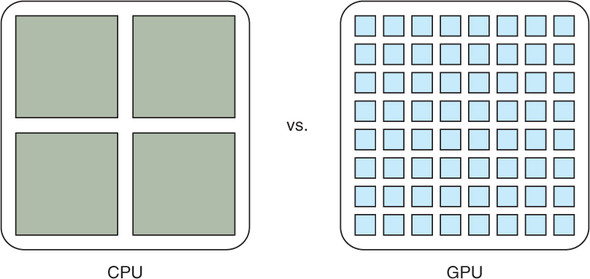
GPUs have become an important and sometimes necessary tool to develop real-world NLP applications. GPUs, first introduced in 2007, are designed to parallelize a large number of computational tasks and to access large amounts of memory. This contrasts the design of CPUs, which are the core of every computer. They’re designed to handle tasks sequentially at a high speed, and they can access their limited processing memory at a high speed (see figure 13.1).
As it turns out, training deep learning models involves various operations that can be parallelized, such as the multiplication of matrices. Similar to graphical animations, which were the initial target market for GPUs, the training of deep learning models is heavily accelerated by parallelized matrix multiplications.