concept group in category nlp

This is an excerpt from Manning's book Getting Started with Natural Language Processing.
How should you approach this task? Let’s first define what represents the core information about the event here. In the meeting events there are three indispensable bits of information: the action of meeting itself and two participants, each of which can be a single person or a group of people. For example, a meeting might take place between two companies, or a president and their administration, and so on. We say that these bits are the core information because one cannot eliminate any of the three: if “X meets Y” saying “X meets”, “X Y” or “meets Y” will be nonsensical as it will raise questions like “Whom X meets?”, “What do X and Y do?” and “Who meets Y?”. In other words, only the phrase like “X meets Y” contains all the necessary information about who does what and who else is involved. So at the very least, you’d want to extract these three bits. Once this is done, you may explore the available information further and, if the text mentions it, find out about the time of the meeting (“X meets Y at noon”, or “X meets Y on Friday”), the purpose (“X meets Y for coffee”) and so on. Now let’s see how you can use Python to do this.
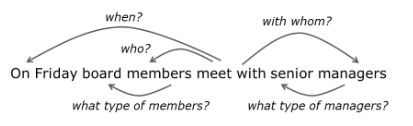
We said before that as we are interested in the action expressed by a verb (like “meet (with)”) and its participants, it is the action that we put at the center or at the root of the whole expression. Having done that, we start working from the verb at the root trying to identify which words or groups of words are related to this action verb. We also say that when the words are related to this verb, they depend on it. In other words, if the action is denoted by the verb “meet”, starting from this verb we try to find words that answer relevant questions: e.g. “who meet(s)?” → “board members”, “meet with whom?” → “senior managers”, “meet when?” → “on Friday”, and so on. It’s as if we are saying that “meet” is the most important, most indispensable, core bit of information here, and the other bits are dependent on it. After all, if it wasn’t for the verb “meet”, the meeting wouldn’t have taken place and there would be no need in extracting any further information! Similarly, in the expression “board members” the core bit is “members” as “board” only provides further clarifications (“what type of members?” → “board”) but without “members” there would be no need in providing this clarifying information. Figure 4.19 visualizes dependencies between words in this sentence, where the arrows explicitly show the direction of relation – they go from the head to the dependent in each pair:
Figure 4.19 Flow of dependencies in “On Friday board members meet with senior managers”. Arrows show the direction of the dependency, from the head to the dependant
Putting verbs at the root of the whole expression as well as dividing words into groups of more important ones (such words are technically called heads) and the ones that provide additional information depending on the heads (such words are called dependants) is a convention adopted in NLP. The approach to parsing that relies on this idea is therefore called dependency parsing.