concept NLP application in category nlp

This is an excerpt from Manning's book Real-World Natural Language Processing.
An NLP application is a software application whose main purpose is to process natural language text and draw some useful information from it. Similar to general software applications, it can be achieved in various forms, such as an offline data-processing script, an offline stand-alone application, a backend service, and a full-stack service with a frontend, depending on its scope and use cases. It can be built for end users to use directly, for other backend services to consume its output, or other businesses to use it as a SaaS (software-as-a-service).
1.3.1 Development of NLP applications
Figure 1.9: Development Cycle of NLP applications
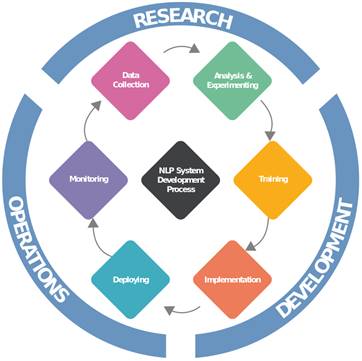
Development of NLP applications is a highly iterative process, consisting of many phases of research, development, and operations (figure 1.9). Most learning materials such as books and tutorials available online focus mainly on the training phase, although all the other phases of application development are equally important for real-world NLP applications. In this section, I’m going to briefly introduce what each stage involves. Note that there is no clear boundary between those phases. It is not uncommon that application developers (researchers, engineers, managers, and other stakeholders) go back and forth between some of these phrases through try and error.
This is an excerpt from Manning's book Getting Started with Natural Language Processing.
The key difference between rule-based approaches and statistical approaches is that the the rule-based approaches rely on a set of very precise but rigid and ultimately inflexible rules, whereas the statistical approaches don’t make assumptions – they try to learn what’s right and what’s wrong from the data, and they can be flexible about their predictions. That is another major component to (and a requirement for) the success of the NLP applications: rule-based systems are costly to build and rely on gathering expertise from humans, but statistical approaches can only work well provided they have access to large amounts of high quality data. For some tasks such data is easier to come by: for example, a renewed interest and major breakthroughs in Machine Translation in the 1980s were due to the availability of the parallel data translated between pairs of languages that could be used by a statistical algorithm to learn from. Not all tasks were as “lucky”.