concept verb in category nlp

This is an excerpt from Manning's book Getting Started with Natural Language Processing.
Words may occur in several different forms. In English, this is relevant for nouns (words denoting objects, people, animals and abstract concepts) and verbs (words denoting actions and states). Mapping the different forms of a word to its base (dictionary) form allows the algorithm to establish useful correspondences and optimize the search space; one step further is to apply a set of rules to identify the correspondences across all related words. To link the related words to each other, use an NLP tool called stemmer that relies on a set of predefined rules.
We’ve said earlier that when we try to figure out what type of a word something like “Jabberwock” is we rely on the context. In particular, the previous words are important to take into account: if we see “the”, chances that the next word is a noun or an adjective are very high, but a chance that we see a verb next is minimal – verbs shouldn’t follow articles in grammatically correct English. Technically, we rely on two types of intuitions: we use our expectations about what types of words typically follow other types of words, and we also rely on our knowledge that words like “fish” can be nouns or verbs but hardly anything else. We perform the task of word type identification in sequence. For instance, in the example from Figure 4.15, when the sentence begins, we already have certain expectations about what type of a word we may see first – quite often, it will be a noun or a pronoun (like “I”). Once we’ve established that it is very likely for a pronoun to start a sentence, we also rely on our intuitions about how likely it is that such a pronoun will be exactly “I”. Then we move on, and expect to see a particular range of word types after a pronoun – almost certainly it should be a normal verb or a modal verb (as verbs denoting obligations like “should” and “must” or abilities like “can” and “may” are technically called). More rarely, it may be a noun (like “I, Jabberwock”), an adjective (“I, frumious Bandersnatch”), or some other part-of-speech. Once we’ve decided that it is a verb, we assess how likely it is that this verb is “can”; if we’ve decided that it is a modal verb, we assess how likely it is that this modal verb is “can”, and so on. We proceed like that until we reach the end of the sentence, and this is where we assess which interpretation we find overall more likely. This is one possible step-wise explanation of how our brain processes information, on which part-of-speech tagging is based.
We said before that in the simplest case, returning the words immediately before and immediately after the word that denotes the action works in some cases. However, in the sentence at hand this doesn’t work: part-of-speech tagging helps you identify that “meet (with)” is an action, however, you would need to return “board members” and “senior managers” as the two participants. So far, the algorithm is only able to detect that “board”, “members” and “managers” are nouns, while “senior” is an adjective, but it hasn’t linked the words together yet. The next step is to identify that “board” and “members” together form one group of words and “senior” and “managers” another group, and these two groups represent the participants in the action as they are both directly related to the verb “meet (with)”. These are not the only words that are related to the action of meeting: in fact, the group of words “On Friday” tells us about the time of the meeting, and “to discuss future development of the company” tells us about the purpose. So, ideally we would like to be able to get all these bits of information. Figure 4.18 visualizes this idea:
Figure 4.18 All bits of information related to the action of meeting as we expect them to be identified by a parser
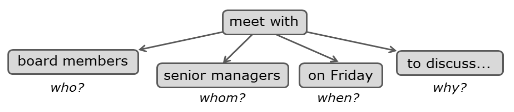
In this representation, we put the action “meet (with)” at the center or root of the whole account of events because it makes it easier to detect other participants that are involved in this action and other bits of information related to it starting from the verb itself.
Word types that we’ve defined in the previous step help us identify the groups of words and their relations to the main action here: it is common for the participants to be expressed with groups of words involving nouns, for locations and time references – to be attached to the verb with a preposition (like “on Friday” or “at the office”), and the purpose of the meeting would often be introduced using “to” and a further expression involving a verb (like “discuss” in this example). We rely on such intuitions when we detect which words are related to each other, and machines use a similar approach as well.