concept Amazon in category nosql
appears as: Amazon,
Amazon

This is an excerpt from Manning's book Making Sense of NoSQL.
Table 1.2. The key case studies associated with the NoSQL movement—the name of the case study/standard, the business drivers, and the results (findings) of the selected solutions
Case study/standard
Driver
Finding
LiveJournal’s Memcache Need to increase performance of database queries. By using hashing and caching, data in RAM can be shared. This cuts down the number of read requests sent to the database, increasing performance. Google’s MapReduce Need to index billions of web pages for search using low-cost hardware. By using parallel processing, indexing billions of web pages can be done quickly with a large number of commodity processors. Google’s Bigtable Need to flexibly store tabular data in a distributed system. By using a sparse matrix approach, users can think of all data as being stored in a single table with billions of rows and millions of columns without the need for up-front data modeling. Amazon’s Dynamo Need to accept a web order 24 hours a day, 7 days a week. A key-value store with a simple interface can be replicated even when there are large volumes of data to be processed. MarkLogic Need to query large collections of XML documents stored on commodity hardware using standard query languages. By distributing queries to commodity servers that contain indexes of XML documents, each server can be responsible for processing data in its own local disk and returning the results to a query server.
Google’s work focused on ways to make distributed batch processing and reporting easier, but wasn’t intended to support the need for highly scalable web storefronts that ran 24/7. This development came from Amazon. Amazon published another significant NoSQL paper: Amazon’s 2007 Dynamo: A Highly Available Key-Value Store. The business motivation behind Dynamo was Amazon’s need to create a highly reliable web storefront that supported transactions from around the world 24 hours a day, 7 days a week, without interruption.
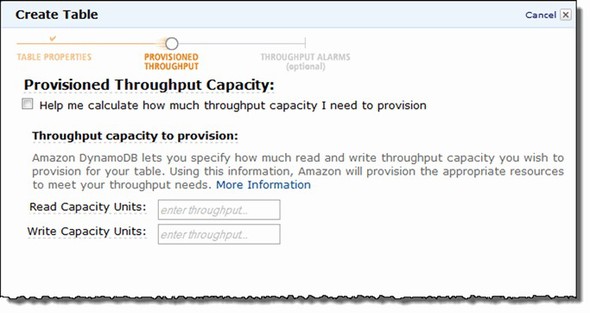
Figure 8.4. Amazon DynamoDB table throughput provisioning. By changing the number of read capacity units or write capacity units, you can tune each table in your database to use the correct number of servers based on your capacity needs. Amazon also provides tools to help you calculate the number of units your application will need.