concept datum in category nosql

This is an excerpt from Manning's book MongoDB in Action, Second Edition: Covers MongoDB version 3.0.
Let’s take a moment to compare MongoDB collections to a standard relational database representation of the same data. Figure 1.1 shows a likely relational analog. Because tables are essentially flat, representing the various one-to-many relationships in your post document requires multiple tables. You start with a posts table containing the core information for each post. Then you create three other tables, each of which includes a field, post_id, referencing the original post. The technique of separating an object’s data into multiple tables like this is known as normalization. A normalized data set, among other things, ensures that each unit of data is represented in one place only.
Figure 1.1. A basic relational data model for entries on a social news site. The line terminator that looks like a cross represents a one-to-one relationship, so there’s only one row from the images table associated with a row from the posts table. The line terminator that branches apart represents a one-to-many relationship, so there can be many rows in the comments table associated with a row from the posts table.
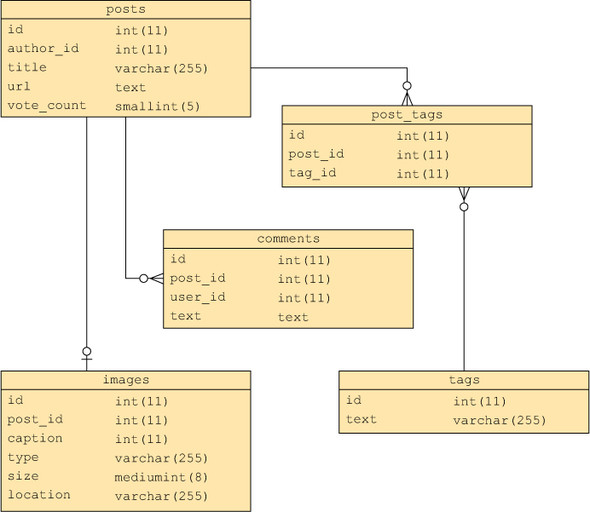
But strict normalization isn’t without its costs. Notably, some assembly is required. To display the post you just referenced, you’ll need to perform a join between the post and comments tables. Ultimately, the question of whether strict normalization is required depends on the kind of data you’re modeling, and chapter 4 will have much more to say about the topic. What’s important to note here is that a document-oriented data model naturally represents data in an aggregate form, allowing you to work with an object holistically: all the data representing a post, from comments to tags, can be fitted into a single database object.
These three sections will give you a basic working knowledge of sharding, but you won’t fully understand how these ideas all come together until you set up your own sharded cluster. That’s what you’ll do in the fourth section, where you’ll build a sample cluster to host data from a massive Google Docs–like application.
The picture has definitely changed. As you can see in figure 12.4, you now have 10 chunks. Naturally, each chunk represents a contiguous range of data.

This is an excerpt from Manning's book Making Sense of NoSQL.
The initial stages of the transformation are called the map operation. They’re responsible for data extraction, transformation, and filtering of data. The results of the map operation are then sent to a second layer: the reduce function. The reduce function is where the results are sorted, combined, and summarized to produce the final result.
The core concepts behind the map and reduce functions are based on solid computer science work that dates back to the 1950s when programmers at MIT implemented these functions in the influential LISP system. LISP was different than other programming languages because it emphasized functions that transformed isolated lists of data. This focus is now the basis for many modern functional programming languages that have desirable properties on distributed systems.
Google extended the map and reduce functions to reliably execute on billions of web pages on hundreds or thousands of low-cost commodity CPUs. Google made map and reduce work reliably on large volumes of data and did it at a low cost. It was Google’s use of MapReduce that encouraged others to take another look at the power of functional programming and the ability of functional programming systems to scale over thousands of low-cost CPUs. Software packages such as Hadoop have closely modeled these functions.
Have you ever wanted to analyze a large amount of data gathered from log files or files you’ve found on the web? The need to quickly analyze large volumes of data is the number-one reason organizations leave the world of single-processor RDBMSs and move toward NoSQL solutions. You may recall our discussion in chapter 1 on the key business drivers: volume, velocity, variability, and agility. The first two, volume and velocity, are the most relevant to big data problems.
Twenty years ago, companies managed datasets that contained approximately a million internal sales transactions, stored on a single processor in a relational database. As organizations generated more data from internal and external sources, datasets expanded to billions and trillions of items. The amount of data made it difficult for organizations to continue to use a single system to process this data. They had to learn how to distribute the tasks among many processors. This is what is known as a big data problem.
Today, using a NoSQL solution to solve your big data problems gives you some unique ways to handle and manage your big data. By moving data to queries, using hash rings to distribute the load, using replication to scale your reads, and allowing the database to distribute queries evenly to your data nodes, you can manage your data and keep your systems running fast.
What’s driving the focus on solving big data problems? First, the amount of publicly available information on the web has grown exponentially since the late 1990s and is expected to continue to increase. In addition, the availability of low-cost sensors lets organizations collect data from everything; for instance, from farms, wind turbines, manufacturing plants, vehicles, and meters monitoring home energy consumption. These trends make it strategically important for organizations to efficiently and rapidly process and analyze large datasets.
Now let’s look at how NoSQL systems, with their inherently horizontal scale-out architectures, are ideal for tackling big data problems. We’ll look at several strategies that NoSQL systems use to scale horizontally on commodity hardware. We’ll see how NoSQL systems move queries to the data, not data to the queries. We’ll see how they use the hash rings to evenly distribute the data on a cluster and use replication to scale reads. All these strategies allow NoSQL systems to distribute the workload evenly and eliminate performance bottlenecks.
Traditional filesystems store data in a single location; if a drive fails, data is restored from a backup drive. By default, files in HDFS are stored in three locations; if a drive fails, the data is automatically replicated to another drive. It’s possible to get the same functionality using a fault-tolerant system like RAID drives. But RAID drives are more expensive and difficult to configure on commodity hardware.
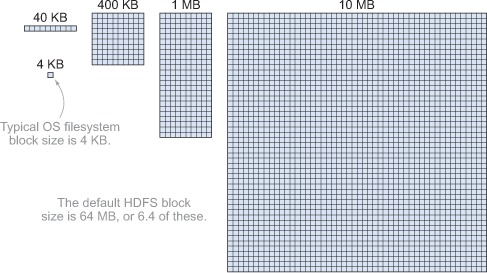
HDFSs are different: they use a large (64 megabytes by default) block size to handle data. Figure 6.9 shows how large HDFS blocks are compared to a typical operating system.
Figure 6.9. The size difference between a filesystem block size on a typical desktop or UNIX operating system (4 KB) and the logical block size within the Apache Hadoop Distributed File System (64 MB), which is optimized for big data transforms. The default block size defines a unit of work for the filesystem. The fewer blocks used in a transfer, the more efficient the transfer process. The downside of using large blocks is that if data doesn’t fill an entire physical block, the empty section of the block can’t be used.
Hash rings are common in big data solutions because they consistently determine how to assign a piece of data to a specific processor. Hash rings take the leading bits of a document’s hash value and use this to determine which node the document should be assigned. This allows any node in a cluster to know what node the data lives on and how to adapt to new assignment methods as your data grows. Partitioning keys into ranges and assigning different key ranges to specific nodes is known as keyspace management. Most NoSQL systems, including MapReduce, use keyspace concepts to manage distributed computing problems.
In chapters 3 and 4 we reviewed the concept of hashing, consistent hashing, and key-value stores. A hash ring uses these same concepts to assign an item of data to a specific node in a NoSQL database cluster. Figure 6.11 is a diagram of a sample hash ring with four nodes.