concept datum node in category nosql
appears as: data nodes, data nodes, data node

This is an excerpt from Manning's book Making Sense of NoSQL.
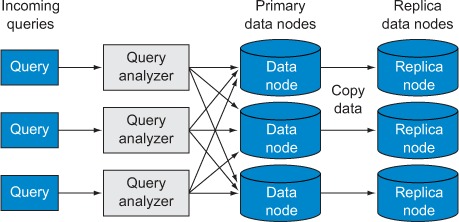
This simple rule helps you understand how NoSQL databases can have dramatic performance advantages over systems that weren’t designed to distribute queries to the data nodes. Consider an RDBMS that has tables distributed over two different nodes. In order for the SQL query to work, information about rows on one table must all be moved across the network to the other node. Larger tables result in more data movement, which results in slower queries. Think of all the steps involved. The tables can be extracted, serialized, sent through the network interface, transmitted over networks, reassembled, and then compared on the server with the SQL query.
Figure 6.13. NoSQL systems move the query to a data node, but don’t move data to a query node. In this example, all incoming queries arrive at query analyzer nodes. These nodes then forward the queries to each data node. If they have matches, the documents are returned to the query node. The query won’t return until all data nodes (or a response from a replica) have responded to the original query request. If the data node is down, a query can be redirected to a replica of the data node.