concept expressivity in category nosql

This is an excerpt from Manning's book Making Sense of NoSQL.
What’s the relationship between scalability and your ability to perform complex queries on your data? As we mentioned earlier, linear scalability is the ability to get a consistent amount of performance improvement as you add additional processors to your cluster. Expressivity is the ability to perform fine-grained queries on individual elements of your dataset.
Understanding how well each NoSQL technology performs in terms of scalability and expressivity is necessary when you’re selecting a NoSQL solution. To select the right system, you’ll need to identify the scalability and expressivity requirements of your system and then make sure the system that you select meets both of these criteria. Scalability and expressivity can be difficult to quantify, and vendor claims may not match actual performance for a particular business problem. If you’re making critical business decisions, we recommend you create a pilot project and simulate an actual load using leased cloud systems.
Figure 6.4 shows a sample chart that ranks systems based on their scalability versus expressivity.
Figure 6.4. A sample of how you might rank scalability (vertical axis) and expressivity (horizontal axis) for your requirements. Simple key-value stores are almost always the least expressive but most scalable. Document stores are usually the most expressive. How you rate scalability and expressivity may depend on your business situation.
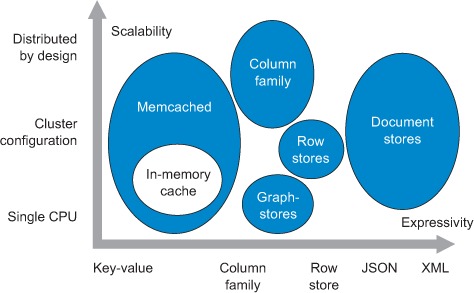
The challenge is that both scalability and expressivity rankings are dependent on your specific business situation. The scalability requirements for some systems might focus on a high number of reads per second and others might focus on writes per second. Other scalability requirements might only specify that a large amount of data be transformed overnight. In the same way, your expressivity could include the requirements for ranked full-text search or the ability to query for annotations within text.
If you’re involved in the software selection process, you want to remember that there’s seldom one perfect solution. The scalability and expressivity analysis is a good example of this trade-off analysis. As we look at other tools to help you make these trade-off decisions, you’ll see that understanding your data will help you classify your big data problems.