concept HDFS in category nosql

This is an excerpt from Manning's book Making Sense of NoSQL.
The Hadoop Distributed File System (HDFS) provides many of the supporting features that MapReduce transforms need to be efficient and reliable. Unlike an ordinary filesystem, it’s customized for transparent, reliable, write-once, read-many operations. You can think of HDFS as a fault-tolerant, distributed, key-value store tuned to work with large files.
Traditional filesystems store data in a single location; if a drive fails, data is restored from a backup drive. By default, files in HDFS are stored in three locations; if a drive fails, the data is automatically replicated to another drive. It’s possible to get the same functionality using a fault-tolerant system like RAID drives. But RAID drives are more expensive and difficult to configure on commodity hardware.
In chapter 6 on managing big data, we introduced the Hadoop Distributed File System (HDFS). As you recall, HDFS can reliably store large files, typically from a gigabyte to a terabyte. HDFS can also tune replication on a file-by-file basis. By default most files in HDFS have a replication factor of 3, meaning that the data blocks that make up these files are located on three distinct nodes. A simple HDFS shell command can change the replication factor for any HDFS file or folder. There are two reasons you should raise the replication factor of a file in HDFS:
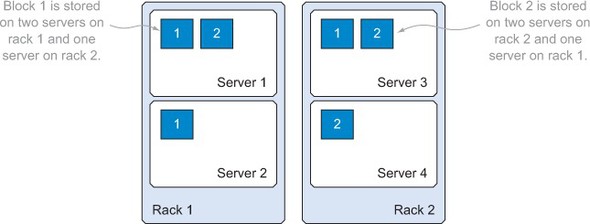
One of the nice features of HDFS is its rack awareness. This is the ability for you to logically group HDFS nodes together in structures that reflect the way processors are stored in physical racks and connected together by an in-rack network. Nodes that are physically stored in the same rack usually have higher bandwidth connectivity between the nodes and using this network keeps data off of other shared networks. This is shown in figure 8.3.
Figure 8.3. HDFS is designed to have rack awareness so that you can instruct data blocks to be spread onto multiple racks, which could be located in multiple data centers. In this example, all blocks are stored on three separate servers (replication factor of 3) and HDFS spreads the blocks over two racks. If either rack becomes unavailable, there will always be a replica of both block 1 and block 2.