concept NoSQL in category nosql

This is an excerpt from Manning's book Making Sense of NoSQL.
One of the challenges with NoSQL is defining it. The term NoSQL is problematic since it doesn’t really describe the core themes in the NoSQL movement. The term originated from a group in the Bay Area who met regularly to talk about common concerns and issues surrounding scalable open source databases, and it stuck. Descriptive or not, it seems to be everywhere: in trade press, product descriptions, and conferences. We’ll use the term NoSQL in this book as a way of differentiating a system from a traditional relational database management system (RDBMS).
For our purpose, we define NoSQL in the following way:
NoSQL is a set of concepts that allows the rapid and efficient processing of data sets with a focus on performance, reliability, and agility.
Seems like a broad definition, right? It doesn’t exclude SQL or RDBMS systems, right? That’s not a mistake. What’s important is that we identify the core themes behind NoSQL, what it is, and most importantly what it isn’t.
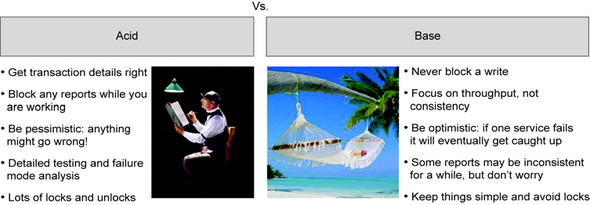
Figure 2.8. ACID versus BASE—understanding the trade-offs. This figure compares the rigid financial accounting rules of traditional RDBMS ACID transactions with the more laid-back BASE approach used in NoSQL systems. RDBMS ACID systems are ideal when all reports must always be consistent and reliable. NoSQL BASE systems are preferred when priority is given to never blocking a write transaction. Your business requirements will determine whether traditional RDBMS or NoSQL systems are right for your application.
With all the architectural advantages of NoSQL for creating cost-effective, high-availability databases, there are drawbacks as well. The principal drawback is that NoSQL systems are relatively new and may contain bugs that become apparent in rare circumstances or unusual configurations. The NoSQL community is full of stories where high-visibility web startups experienced unexpected downtimes using new versions of NoSQL software without adequate training of their staff and enough time and budget to do load and stress testing.
Load and stress testing take time and resources. To be successful, your project may need the people with the right training and experience using the same tools and configuration you have. With NoSQL still newer than traditional RDBMSs, the training budgets for your staff need to be adjusted accordingly.