concept query in category nosql
This is an excerpt from Manning's book MongoDB in Action, Second Edition: Covers MongoDB version 3.0.
Indexes in MongoDB are implemented as a B-tree data structure. B-tree indexes, also used in many relational databases, are optimized for a variety of queries, including range scans and queries with sort clauses. But WiredTiger has support for log-structured merge-trees (LSM) that’s expected to be available in the MongoDB 3.2 production release.
Most databases give each document or row a primary key, a unique identifier for that datum. The primary key is generally indexed automatically so that each datum can be efficiently accessed using its unique key, and MongoDB is no different. But not every database allows you to also index the data inside that row or document. These are called secondary indexes. Many NoSQL databases, such as HBase, are considered key-value stores because they don’t allow any secondary indexes. This is a significant feature in MongoDB; by permitting multiple secondary indexes MongoDB allows users to optimize for a wide variety of queries.
MongoDB doesn’t use SQL. It instead features its own JSON-like query language. You’ve explored this language throughout the book, but now let’s turn to some meatier, real-world examples. You’ll revisit the e-commerce data model introduced in the previous chapter and present a variety of queries against it. Among the queries you’ll practice are _id lookups, ranges, ordering, and projections. This chapter then surveys the MongoDB query language as a whole, looking at each available query operator in detail.
Keep in mind as you’re reading this chapter that MongoDB’s query language and aggregation functions (which chapter 6 covers) are still works in progress, and refinements are being added with each release. As it stands, mastering queries and aggregations in MongoDB isn’t so much a matter of mapping out every nook as it is finding the best ways to accomplish everyday tasks. Through the examples in this chapter, you’ll learn the clearest routes to take. By the end of the chapter, you should have a good intuitive understanding of queries in MongoDB, and you’ll be ready to apply these tools to the design of application schemas.
Siblings are any other categories with the same parent ID, so the query for siblings is straightforward. Because products all contain an array of category IDs, the query for finding all products in a given category is also trivial. You can imagine providing alternative sort methods (by name, price, and so forth). For those cases, you change the sort field.

This is an excerpt from Manning's book Making Sense of NoSQL.
MarkLogic defined two types of nodes in a cluster: query and document nodes. Query nodes receive query requests and coordinate all activities associated with executing a query. Document nodes contain XML documents and are responsible for executing queries on the documents in the local filesystem.
Query requests are sent to a query node, which distributes queries to each remote server that contains indexed XML documents. All document matches are returned to the query node. When all document nodes have responded, the query result is then returned.
The MarkLogic architecture, moving queries to documents rather than moving documents to the query server, allowed them to achieve linear scalability with petabytes of documents.
Today, using a NoSQL solution to solve your big data problems gives you some unique ways to handle and manage your big data. By moving data to queries, using hash rings to distribute the load, using replication to scale your reads, and allowing the database to distribute queries evenly to your data nodes, you can manage your data and keep your systems running fast.
In order to get high performance from queries that span multiple nodes, it’s important to separate the concerns of query evaluation from query execution. Figure 6.13 shows this structure.
Figure 6.13. NoSQL systems move the query to a data node, but don’t move data to a query node. In this example, all incoming queries arrive at query analyzer nodes. These nodes then forward the queries to each data node. If they have matches, the documents are returned to the query node. The query won’t return until all data nodes (or a response from a replica) have responded to the original query request. If the data node is down, a query can be redirected to a replica of the data node.
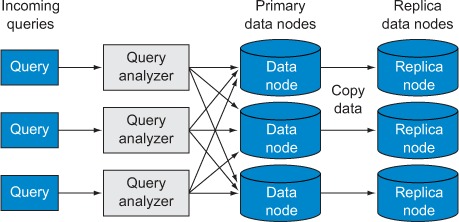
The approach shown in figure 6.13 is one of moving the query to the data rather than moving the data to the query. This is an important part of NoSQL big data strategies. In this instance, moving the query is handled by the database server, and distribution of the query and waiting for all nodes to respond is the sole responsibility of the database, not the application layer.