concept web page in category nosql
appears as: web pages, web page, web page, web pages

This is an excerpt from Manning's book Making Sense of NoSQL.
Table 1.2. The key case studies associated with the NoSQL movement—the name of the case study/standard, the business drivers, and the results (findings) of the selected solutions
Case study/standard
Driver
Finding
LiveJournal’s Memcache Need to increase performance of database queries. By using hashing and caching, data in RAM can be shared. This cuts down the number of read requests sent to the database, increasing performance. Google’s MapReduce Need to index billions of web pages for search using low-cost hardware. By using parallel processing, indexing billions of web pages can be done quickly with a large number of commodity processors. Google’s Bigtable Need to flexibly store tabular data in a distributed system. By using a sparse matrix approach, users can think of all data as being stored in a single table with billions of rows and millions of columns without the need for up-front data modeling. Amazon’s Dynamo Need to accept a web order 24 hours a day, 7 days a week. A key-value store with a simple interface can be replicated even when there are large volumes of data to be processed. MarkLogic Need to query large collections of XML documents stored on commodity hardware using standard query languages. By distributing queries to commodity servers that contain indexes of XML documents, each server can be responsible for processing data in its own local disk and returning the results to a query server.
Table 4.1. NoSQL data architecture patterns—the most important patterns introduced by the NoSQL movement, brief descriptions, and examples of where these patterns are typically used
Pattern name
Description
Typical uses
Key-value store A simple way to associate a large data file with a simple text string Dictionary, image store, document/file store, query cache, lookup tables Graph store A way to store nodes and arcs of a graph Social network queries, friend-of-friends queries, inference, rules system, and pattern matching Column family (Bigtable) store A way to store sparse matrix data using a row and a column as the key Web crawling, large sparsely populated tables, highly-adaptable systems, systems that have high variance Document store A way to store tree-structured hierarchical information in a single unit Any data that has a natural container structure including office documents, sales orders, invoices, product descriptions, forms, and web pages; popular in publishing, document exchange, and document search
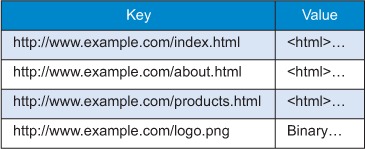
When you use your web browser, you usually enter a web address such as http://www.example.com/hello.html. This uniform resource locator, or URL, represents the key of a website or a web page. You can think of the web as a single large table with two columns, as depicted in figure 4.8.