concept head in category oculus rift
appears as: head, head

This is an excerpt from Manning's book Oculus Rift in Action.
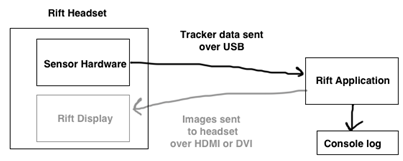
The headset contains the head tracking hardware that reports both acceleration and rotational velocity at a rate of 1,000 times per second.
The runtime solves this problem by centralizing access to the hardware to the runtime process. The exclusive hardware functions are now contained within the runtime. Other applications use the SDK to access the tracking information via shared memory. The fine details of this process are abstracted behind the API. From a developer’s perspective, you can simply call the function to get the head pose and receive up to date information, regardless of how many other applications are accessing the Rift.
Figure 2.4: Getting input from the head tracker
Listing 3.1 Structures used for head tracking
typedef struct ovrPosef_ #A { ovrQuatf Orientation; ovrVector3f Position; } ovrPosef; typedef struct ovrPoseStatef_ #B { ovrPosef ThePose; ovrVector3f AngularVelocity; ovrVector3f LinearVelocity; ovrVector3f AngularAcceleration; ovrVector3f LinearAcceleration; double TimeInSeconds; } ovrPoseStatef; typedef struct ovrSensorData_ #C { ovrVector3f Accelerometer; ovrVector3f Gyro; ovrVector3f Magnetometer; float Temperature; float TimeInSeconds; } ovrSensorData; typedef struct ovrTrackingState_ #D { ovrPoseStatef HeadPose; ovrPosef CameraPose; ovrPosef LeveledCameraPose; ovrSensorData RawSensorData; unsigned int StatusFlags; } ovrTrackingState; #A A pose holds the orientation and position of a tracked object relative to some fixed origin. #B A pose state holds a pose, information about the speed and acceleration of the tracked object and the time of the sample taken. #C The sensor data structure contains the most recent raw information from the sensors #D The tracking state structure contains a pose state for the head, with two variants of a pose for the camera, some raw sensor data and a bit-field for status flags.