concept MapReduce in category opencl

This is an excerpt from Manning's book OpenCL in Action: How to Accelerate Graphics and Computation.
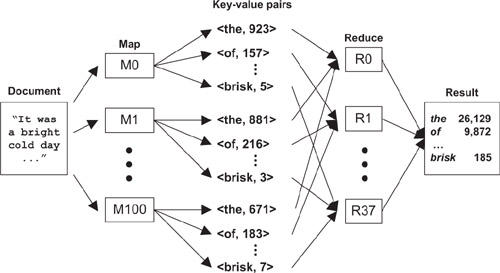
The goal of MapReduce isn’t to solve a particular problem, but to provide a framework for solving a class of problems that involve distributed processing. A basic MapReduce implementation consists of a mapping stage, which produces key-value pairs from input data, and a reduction stage, which processes the key-value pairs to produce output data. MapReduce is usually associated with cluster computing, but this chapter will examine how it can be executed on OpenCL-compliant hardware.
In 2004, Google engineers Jeffrey Dean and Sanjay Ghemawat released a research paper entitled MapReduce: Simplified Data Processing on Large Clusters (http://labs.google.com/papers/mapreduce.html). The paper caused a sensation in the world of cluster computing, and not just because of the theory—the concepts of mapping and reduction had long been used in the field of functional programming. The paper became famous because Google, whose meteoric $1.67 billion IPO had taken place four months prior, was divulging the technical secrets behind its success. The paper discusses both the theory of MapReduce and Google’s implementation of the algorithm in its server clusters. MapReduce quickly became a topic of interest throughout high-tech corporations and academia, and that interest has continued unabated into the present.
Put simply, MapReduce is a method for processing large data sets with large numbers of processors. It doesn’t focus on any particular processing task, but instead presents an approach that can be applied to multiple applications. If you’re familiar with the concept of a design pattern, then you have a good idea of the role MapReduce serves in the world of parallel programming.