concept model in category opencl

This is an excerpt from Manning's book OpenCL in Action: How to Accelerate Graphics and Computation.
After examining different types of data, we’ll look at how and where this data is stored. OpenCL has a model for devices that includes four different address spaces. The final sections of this chapter will discuss these spaces and how to configure data storage in code.
The names resemble each other, but OpenCL and OpenGL serve very different purposes. While OpenCL is used for general computation, OpenGL (Open Graphics Language) is concerned with rendering 3-D graphics. By rendering, I mean that OpenGL accepts a model composed of three-dimensional figures and produces a two-dimensional array of pixels that can be drawn in a window. This rendering executes in a loop, and if the properties of the figures change, the renderer will update the drawing. Figure B.1 provides an example of a static rendering.
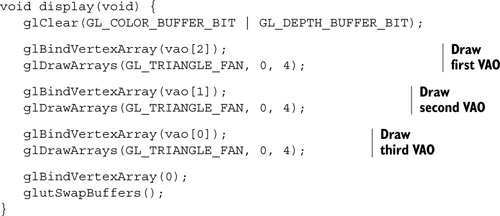
Here, glDrawArrays is called three times—once for each vertex array object configured in the init_buffers function. This draws each of the three squares of the model. Figure B.5 shows what the result looks like.