concept metadata in category osgi

This is an excerpt from Manning's book OSGi in Action: Creating Modular Applications in Java.
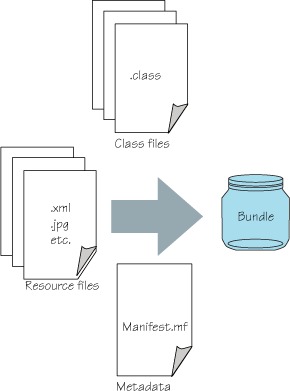
The module layer defines the OSGi module concept, called a bundle, which is a JAR file with extra metadata (data about data). A bundle contains your class files and their related resources, as depicted in figure 1.5. Bundles typically aren’t an entire application packaged into a single JAR file; rather, they’re the logical modules that combine to form a given application. Bundles are more powerful than standard JAR files, because you can explicitly declare which contained packages are externally visible (that is, exported packages). In this sense, bundles extend the normal access modifiers (public, private, and protected) associated with the Java language.
You may be thinking that you already do imports in your source code with the import keyword. Conceptually, the import keyword and declaring OSGi imports are similar, but they serve different purposes. The import keyword in Java is for namespace management; it allows you to use the short name of the imported classes instead of using its fully qualified class name (for example, you can refer to SimpleShape rather than org.foo.shape.SimpleShape). You can import classes from any other package to use their short name, but it doesn’t grant any visibility. In fact, you never need to use import, because you can use the fully qualified class name instead. For OSGi, the metadata for importing external code is important, because it’s how the framework knows what your bundle needs.