concept memory bandwidth in category parallel computing

This is an excerpt from Manning's book Parallel and High Performance Computing.
Many mesh-based applications distribute their mesh across processors in a distributed memory implementation as shown in figure 1.13. Because of this, they will need to update the boundaries of their mesh with values from an adjacent processor. This operation is called a ghost cell update. The MiniGhost mini-app was developed to experiment with different ways to perform this operation. The MiniGhost mini-app is part of the Mantevo suite of mini-apps available at https://mantevo.org/default.php.
We have two different methods that are used for measuring the bandwidth -- the stream benchmark and the roofline model measured by the empirical roofline toolkit. The stream benchmark was created by John McCalpin around 1995 to support his argument that memory bandwidth is far more important than the peak floating point capability. The roofline model (see figure 3.6 and the discussion later in this section), in comparison, integrates both the memory bandwidth limit and the peak flop rate into a single plot with regions that show each performance limit. The empirical roofline toolkit was created to measure and plot the roofline model.
The stream benchmark measures the time to read and write a large array. There are four variants depending on the operations performed on the data by the CPU as it is being read. There is a copy, scale, add and triad measurement. The copy does no floating point work, the scale and add do one arithmetic operation and the triad does two. These each give a slightly different measure of the maximum rate that data can be expected to be loaded from main memory for the case that each data value is only used once. In this regime, the flop rate is limited by how fast memory can be loaded.
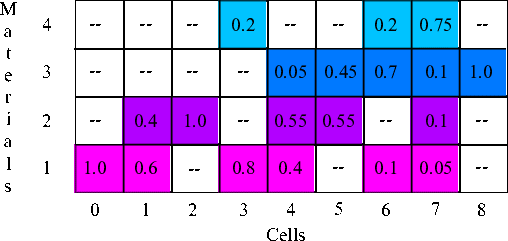
Figure 4.15 The material-centric full matrix data structure has cells stored contiguously for each material. The array indexing in C would be density[m][C] with the cell index contiguous. The cells with dashes are filled with zeros.