concept MPI in category parallel computing

This is an excerpt from Manning's book Parallel and High Performance Computing.
What are some other examples of parallel operations in your daily life? How would you classify your example? What does the parallel design appear to optimize for? Can you compute a parallel speedup for this example?
- For your [desktop, laptop, cell-phone], what is the theoretical parallel processing power of your system in comparison to its serial processing power? What kinds of parallel hardware are present in it?
- Which parallel strategies do you see in the store checkout example in figure 1.1? Are there some present that are not shown. How about in your examples from exercise 1?
- You have an image processing application that needs to process 1000 images daily that are 4 mebibytes (MiB, 220 or 1,048,576 bytes) each in size. It takes 10 minutes in serial to process each image. Your cluster is composed of multi-core nodes with 16 cores and a total of 16 gibibytes (GiB, 230 bytes, or 1024 mebibytes) of main memory storage per node. Note that we are using the proper binary terms, MiB and GiB, rather than MB and GB which are the metric terms for 106 and 109 bytes, respectively.
- a) What parallel processing design best handles this workload?
- b) Now customer demand increases by 10x. Does your design handle this? What changes would you have to make?
- An Intel Xeon E5-4660 Processor has a thermal design power of 130 W; this is the average power consumption rate when all 16 cores are used. Nvidia’s Tesla V100 GPU and AMD’s MI25 Radeon GPU have a thermal design power of 300 W. Suppose you port your software to use one of these GPUs. How much faster should your application run on the GPU to be considered more energy efficient than your 16 core CPU application?
MPI is ubiquitous in the field of high performance computing. Across many scientific fields, the use of supercomputers entails an MPI implementation. MPI was launched as an open standard in 1994 and within months had become the dominant parallel computing library-based language. Since 1994, the use of MPI has led to scientific breakthroughs from physics to machine learning and self-driving cars!
Several implementations of MPI are now in widespread use. MPICH from Argonne National Laboratories and OpenMPI are two of the most common. Hardware vendors often have customized versions of one of these two implementations for their own platform. The MPI standard, now up to version 3.1 in 2015, continues to evolve and change.
In this chapter, we’ll show you how to implement MPI in your application[1]. We’ll start with a simple MPI program and then move on to how to link together separate computational meshes on separate processes through communicating boundary information. We’ll touch on some advanced techniques that are important for well-written MPI programs such as building custom MPI datatypes, the use of MPI cartesian topology functions and the combination of MPI with OpenMP and vectorization to get multiple levels of parallelism.
make clean
    make distclean
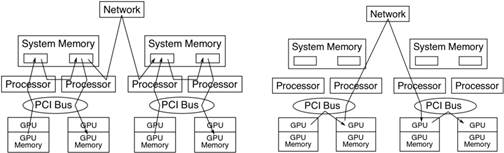
Figure 9.10 On the left is the standard data movement for sending data from a GPU to other GPUs. On the right, the data movement bypasses the CPU when moving data from one GPU to another.