concept section in category parallel computing
appears as: section, sections, section

This is an excerpt from Manning's book Parallel and High Performance Computing.
Add (Best 2016) to each term as in Parallel Speedup (Best 2016) and Comparative Speedup (Best 2016) to indicate that the comparison is between the best hardware released in a particular year. This might be a high-end GPU vs a high-end CPU released in 2016.
+-----------------------------------+------------+
|  ...                              |            |
|             DP MFLOP/s            |  3923.4952 |
|           AVX DP MFLOP/s          |  3923.4891 |
|  ...                              |            |
|       Operational intensity       |     0.247  |
+-----------------------------------+------------+
Now we start showing you how to apply each of the OpenMP concepts and directives. In this section you will learn how to create a region of code with multiple threads using the OpenMP parallel pragma on a traditional ‘Hello World’ problem distributed among threads. You will see how easy it is to use OpenMP and acquire potential performance gains. There are several ways to control how many threads you have in the parallel region.
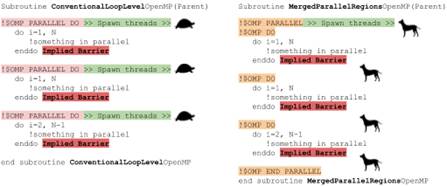
Figure 7.9 High-level OpenMP starts with a loop-level OpenMP implementation and starts by merging parallel regions together to reduce the cost of thread spawning. Here, we are using the animal images to represent where the changes are made and the relative speed of the actual implementation. The conventional loop level OpenMP shown with the turtle is faster, but there is overhead with each parallel do that limits the speedup. The dog represents the relative gain in speed from merging parallel regions.