concept menu in category php

This is an excerpt from Manning's book PHP in Action: Objects, Design, Agility.
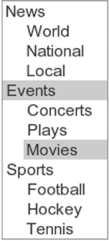
Let’s try an example: a menu for navigation on a web page such as the example in figure 7.4. Even if we have only one set of menu headings, there are still implicitly three levels of menus, since the structure as a whole is a menu. This makes it a strong candidate for a Composite structure.
The menu has only what little functionality is needed to illustrate the Composite. We want the structure itself and the ability to mark the current menu option and the path to it. If we’ve chosen Events and then Movies, both Events and Movies will be shown with a style that distinguishes them from the rest of the menu, as shown in figure 7.7.
First, let’s sketch the objects for the first two submenus of this menu. Figure 7.8 shows how it can be represented. Each menu has a set of menu or menu option objects stored in instance variables, or more likely, in one instance variable which is an array of objects. To represent the fact that some of the menus and menu options are marked, we have a simple Boolean (TRUE/FALSE flag). In the HTML code, we will want to represent this as a CSS class, but we’re keeping the HTML representation out of this for now to keep it simple. Furthermore, each menu or menu option has a string for the label. And there is a menu object to represent the menu as a whole. Its label will not be shown on the web page, but it’s practical when we want to handle the menu.