concept type name in category powershell

This is an excerpt from Manning's book PowerShell in Depth, Second Edition.
Consider some of the things you might use to describe a television or a car; these are the properties of the objects. Obviously, each different type of object will have a different set of properties, so one of the things you’ll always want to keep in mind is the type name of the object you’re working with. Table 7.1 provides some examples.
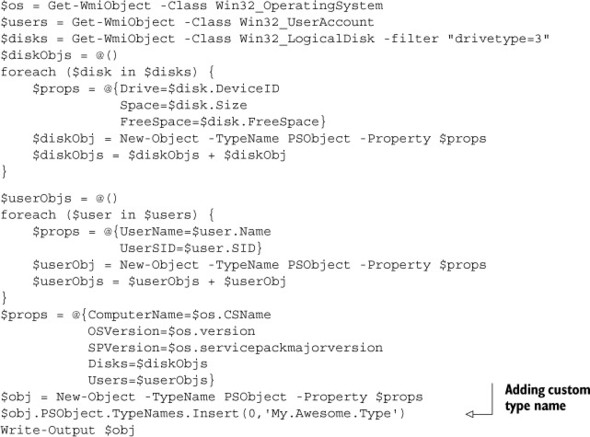
There’s nothing wrong with all of these objects having the same type, unless you want to apply a custom format view or a custom type extension (something we cover in upcoming chapters). Those custom extensions require an object to have a unique name so that PowerShell can identify the object and apply the extension appropriately. Giving one of your objects a custom name is easy—just do so before outputting it to the command line. We’ll revise listing 21.6, as shown in listing 21.9, to add a custom type name. This technique isn’t needed if the syntax from listing 21.7 is used because you define a type name when creating the class.