concept bayesian network in category probabilistic programming

This is an excerpt from Manning's book Practical Probabilistic Programming.
Every probabilistic reasoning system uses a representation language to express its probabilistic models. There are a lot of representation languages out there. You may have heard of some of them, such as Bayesian networks (also known as belief networks) and hidden Markov models. The representation language controls what models can be handled by the system and what they look like. The set of models that can be represented by a language is called the expressive power of the language. For practical applications, you’d like to have as large an expressive power as possible.
A Bayesian network is a representation of a probabilistic model consisting of three components:
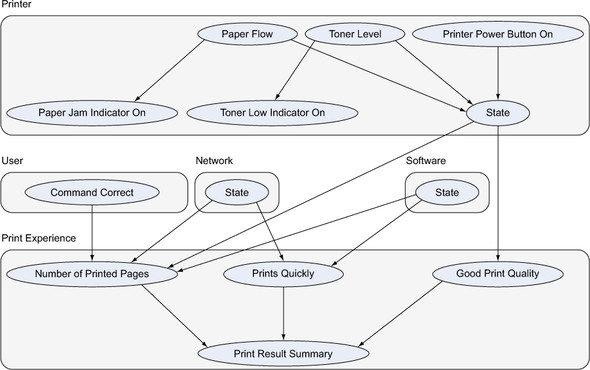
A Bayesian network encodes a lot of independencies that hold between variables. Recall that independence between two variables means that learning something about one variable doesn’t tell you anything new about the other variable. From the preceding example, you can see that Number of Printed Pages and Printer Power Button On aren’t independent. When you learn that no pages were printed, that reduces the probability that the power button is on.
Conditional independence is similar. Two variables are conditionally independent given a third variable if, after the third variable is known, learning something about the first variable doesn’t tell you anything new about the second. A criterion called d-separation determines when two variables in a Bayesian network are conditionally independent of a third set of variables. The criterion is a little involved, so I won’t provide a formal definition. Instead, I’ll describe the basic principles and show you a few examples.
The basic idea is that reasoning flows along a path from one variable to another. In the example of figure 5.4, reasoning can flow from Size to Brightness along the path Size-Subject-Brightness. You saw a glimpse of this idea in section 5.1.3 on direct and indirect dependencies. In an indirect dependency, reasoning flows from one variable to another variable via other intermediary variables. In this example, Subject is the intermediary variable between Size and Brightness. In a Bayesian network, reasoning can flow along a path as long as the path isn’t blocked at some variable.
Figure 7.2. Object-oriented representation of the printer Bayesian network. The shaded boxes group related variables. The label at the top left of these boxes is the name of the class. Notice how this model provides the structure that wasn’t apparent in the Bayesian network of figure 7.1.