concept learn component in category probabilistic programming

This is an excerpt from Manning's book Practical Probabilistic Programming.
As you may recall from chapter 1, a probabilistic reasoning system uses an inference algorithm operating on a model to answer a query, given evidence. In this case, the system uses a model of normal and spam emails, contained in the email model. The query is whether the email is spam, and the answer is the spam probability. In order to work, the reasoning component needs to get the email model from somewhere. Where does it come from? It’s learned from training data by a learning component.
Figure 3.2 shows the process by which the learning component produces the email model. This is an offline component; the process doesn’t happen with every email and is allowed to take a long time to produce the best model it possibly can. The learning component has to finish its job and produce the email model before the reasoning component can run. After it’s finished, the learning component isn’t needed anymore, unless you want to update the email model at some future date.
Figure 3.2. How a learning component produces the email model. This learning process can take a long time and happens offline.
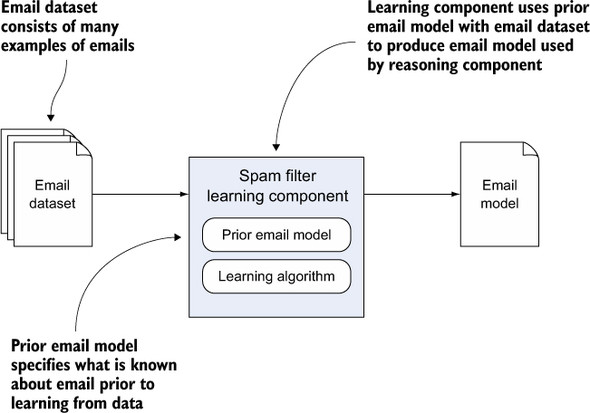
The learning component uses training data consisting of a set of emails. This dataset includes both normal and spam emails, but they don’t necessarily have to be all labeled as normal or spam. The learning component doesn’t start without any knowledge; rather, it uses a learning algorithm operating on the dataset to take a prior email model and turn it into the email model used by the reasoning component. At this point, you might be thinking that I’ve just punted the issue of creating the model. If the goal of the learning component is to create the email model, where does the prior email model come from?