concept learning component in category probabilistic programming

This is an excerpt from Manning's book Practical Probabilistic Programming.
The learning component uses training data consisting of a set of emails. This dataset includes both normal and spam emails, but they don’t necessarily have to be all labeled as normal or spam. The learning component doesn’t start without any knowledge; rather, it uses a learning algorithm operating on the dataset to take a prior email model and turn it into the email model used by the reasoning component. At this point, you might be thinking that I’ve just punted the issue of creating the model. If the goal of the learning component is to create the email model, where does the prior email model come from?
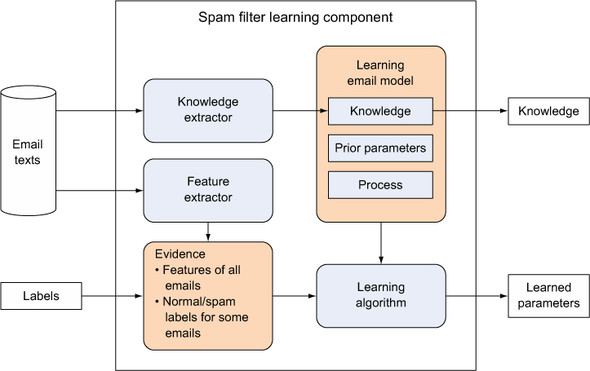
After you’ve defined the model and built the reasoning component, you already have most of the pieces in place for the learning component. Let’s take another look at the architecture of the learning component, reproduced in figure 3.10. You’ve already seen the email model. As mentioned, a difference between the learning email model and the one used for reasoning is that the learning model uses prior parameters consisting of Beta elements for each parameter of the model.
You’ve also seen the feature extractor in the reasoning component and how the evidence is applied, given an email and an optional normal/spam label. In the reasoning component, you reasoned about a single email. In contrast, in the learning component, you have an entire training set of emails. Your feature extractor will extract the features of all the emails and compile the evidence for each one. It will also read a Labels file that contains labels for some of the emails in the training set, and apply the appropriate evidence if there’s a label.