concept operation in category probabilistic programming

This is an excerpt from Manning's book Practical Probabilistic Programming.
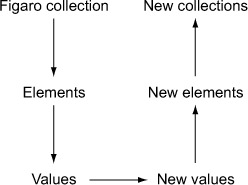
Figaro collections are special because they know that the things they contain are elements, which define probability distributions over values. They let you reach inside the elements and work with operations on the values. Figure 6.4 illustrates how this works.
The operation you’ve performed goes by two common names. One is the factor sum. Don’t be confused: sum doesn’t mean that you’re adding two factors, but that you’re adding numbers in rows of a single factor to produce a new, simpler factor. When you perform the sum operation, you remove some of the variables from the resulting factor; in our example, you’ve removed Subject and Size. You say that you’re summing over these variables. The other name you’ll see sometimes is marginalization. The resulting probability distribution over Brightness is called the marginal probability, as opposed to the joint distribution you started with. I’ll avoid using the term marginalization, but the concept of factor sum will be an important one as we go forward with factored inference.