concept parameter in category probabilistic programming

This is an excerpt from Manning's book Practical Probabilistic Programming.
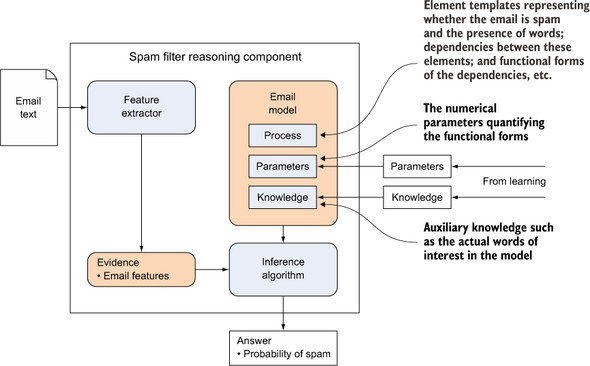
It’s time to take a closer look at the model. Figure 3.5 shows a refinement of the reasoning architecture that breaks the model into three parts: the process, which contains structural knowledge programmed in by the model designer; the parameters, which are learned from the data; and auxiliary knowledge that’s not directly related to elements but is used for reasoning.
The preceding chapter described several alternative kinds of queries you could ask of a probabilistic model. This chapter continues the theme by presenting two more reasoning tasks, both of which are important and widely used. The first task, discussed in section 13.1, is monitoring the state of a dynamic system over time as you receive information from sensors. The second task, presented in section 13.2, is learning the parameters of a probabilistic model from data. Although the techniques used for these two kinds of reasoning are different, both fall in the category of advanced methods that are necessary in many applications. It’s well worth your while to understand these methods and how to use them. The chapter concludes with a brief section on taking what you’ve learned in this book and moving beyond it in your use of Figaro.