concept posterior probability distribution in category probabilistic programming

This is an excerpt from Manning's book Practical Probabilistic Programming.
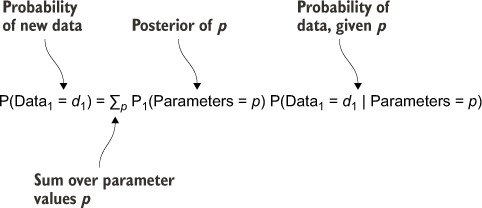
This probability distribution, before you see any evidence, is commonly called the prior probability distribution. The name, naturally, means that it’s prior to any considerations about the here-and-now (prior to seeing the evidence). It’s contrasted with the posterior probability distribution, which is the distribution you get after considering the evidence. Likewise, the P(Rembrandt) computed in the previous paragraph is called the prior probability of this fact, as opposed to the posterior probability you’ll get after looking at the evidence. You’ll see how to take the evidence into account to get the posterior probability in the next section.
The process of using the probability distribution to take into account the evidence is called conditioning on the evidence. The result of conditioning is also a probability distribution and is known as the posterior probability distribution.