concept probabilistic model in category probabilistic programming

This is an excerpt from Manning's book Practical Probabilistic Programming.
In this book, you’ll learn probabilistic reasoning through probabilistic programming. You’ll learn, first of all, what a probabilistic model is and how it can be used to draw conclusions. You’ll also learn some basic manipulations that are performed to draw those conclusions from a model made up of simple components. You’ll learn a variety of modeling techniques and how to implement them by using probabilistic programming. You’ll also gain an understanding of how the probabilistic inference algorithms work, so you can design and use your models effectively. By the end of this book, you’ll be able to use probabilistic programming confidently to draw useful conclusions that inform your decisions in the face of uncertainty.
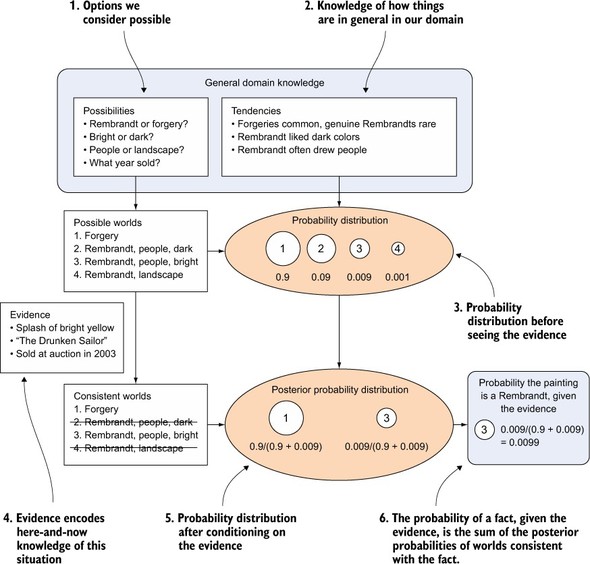
A probabilistic model is a way of encoding the general knowledge you have of an uncertain situation. Imagine, for example, that you’re an art expert who’s trying to decide whether a painting is a genuine Rembrandt or a forgery. You have the following pieces of information: