concept transition model in category probabilistic programming

This is an excerpt from Manning's book Practical Probabilistic Programming.
3. Specify the transition model. The transition model defines how the state at one time point depends on the state at the previous time point. In figure 8.1, the transition model specifies the probability of Possession(1) given Possession(0), and the probability of Possession(2) given Possession(1), and so on. In symbols, the transition model specifies P(Possession(t) | Possession(t – 1)) for any t ≥ 1.
As you can see from this list, the main content of the DBN specification is in the transition model. Typically, rather than show the sequence of variables over time, as in figure 8.3 (which shows variables at times 0, 1, 2, and so forth), it’s typical to show the relationship between a time step and the previous time step. This relationship is called a two time-step Bayesian network, or 2TBN for short. Figure 8.4 shows the 2TBN for our running example.
Figure 8.4. A two-time-step Bayesian network (2TBN) for our example. The 2TBN shows the variables at time step t and their dependence on time step t – 1.
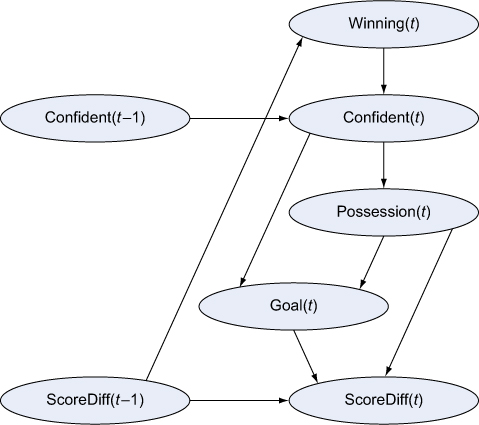
As you can see from the figure, a 2TBN is similar to an ordinary Bayesian network in which the variables are the state variables of the DBN at time steps t and t – 1. The only difference is that the variables at time step t – 1 have no parents and no CPDs; only the dependencies and distributions of the variables at time step t are defined. The 2TBN is an encoding of the transition model of the DBN previously described, and is the usual way the DBN is depicted.
Now for the interesting part: the transition model. You’ll write it in two steps. First, you’ll write the skeleton of the transition model, and then you’ll fill in the details. Here’s the skeleton.