concept car in category python
This is an excerpt from Manning's book Math for Programmers: 3D graphics, machine learning, and simulations with Python.
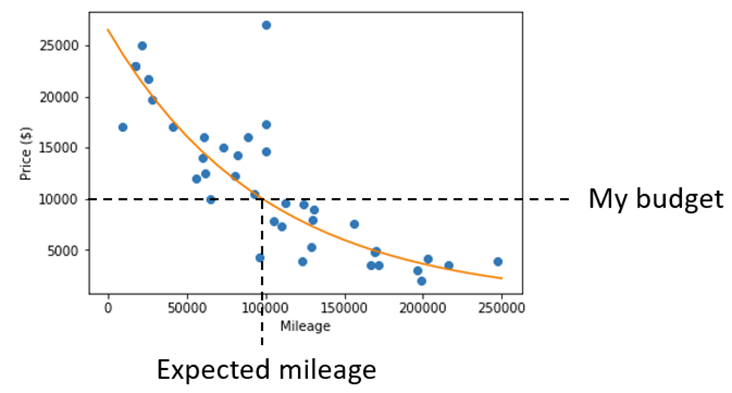
Equation 1.1 shows that the best fit price is $26,500 times 0.905 raised to the power of the mileage. Plugging the values into the equation, I find that if my budget is $10,000, then I should buy a Prius with about 97,000 miles on it (figure 1.6). If I believe the curve indicates a fair price, then cars below the line should typically be good deals.
Figure 1.6: Finding the mileage I should expect on a used Prius for my $10,000 budget
But we can learn more from equation 1.1 than just how to find a good deal. It tells a story about how cars depreciate. The first number in the equation is $26,500, which is the exponential function’s understanding of the price at zero mileage. This is an impressively close match to the retail price of a new Prius. If we use a line of best fit, it implies a Prius loses a fixed amount of value with each mile driven. This exponential function says, instead, that it loses a fixed percentage of its value with each mile driven. After driving 10,000 miles, a Prius is only worth 0.905 or 90.5% of its original price according to this equation. After 50,000 miles, we multiply its price by a factor of (0.905)5 = 0.607. That tells us that it’s worth about 61% of what it was originally.
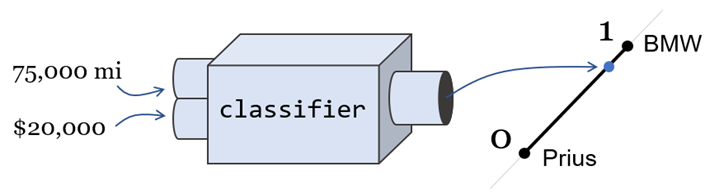
In this chapter, we look at the same simple data set as in the last chapter: mileages and prices of used cars. Instead of using data for a single model of car like in the last chapter, we’ll look at two car models: Toyota Priuses and BMW 5 series sedans. Based only on the numeric data of the car’s mileage and price, and a reference data set of known examples, we want our algorithm to give us a yes or no answer as to whether the car is a BMW. As opposed to a regression model that takes in a number and produces another number, the classification model will take in a vector and produce a number between zero and one, representing the confidence that the vector represents a BMW instead of a Prius (figure 15.1).
Figure 15.1: Our classifier takes a vector of two numbers, the mileage and price of a used car, and returns a number representing its confidence that the car is a BMW.
true positives 18.000000 true negatives 100.000000 false positives 0.000000 false negatives 82.000000
Because the classifier returns no false positives, this tells us it always correctly identifies when the car is not a BMW. But we can’t be too proud of our function yet, because it says most of the cars are not BMWs, including many that are! In the next exercise, you can relax the constraint to get a higher overall success rate.