concept class in category python

This is an excerpt from Manning's book The Well-Grounded Python Developer.
Another important aspect of writing maintainable code is making it flexible. It's difficult to anticipate how the functions and classes you create might be used further on in the development of an application.
The first thing to do is to define a class for a rectangle to draw on the screen. Starting with the UML diagram for the Rectangle class:
Figure 5.2
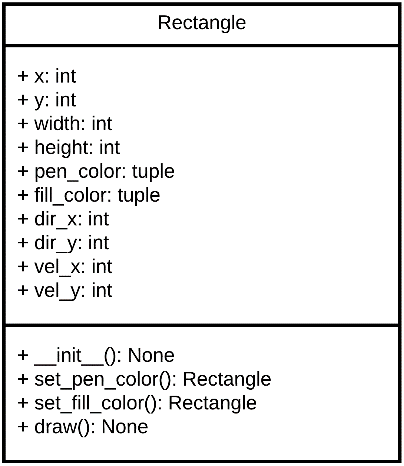
The UML diagram shows the attributes encapsulated in the class necessary to render a rectangle on-screen. All of these attributes are initialized during the construction of a Rectangle object:
Creating classes and class hierarchies gives you another way to create code that's clean and well-controlled in how it's used. Classes are another avenue to give your users an API into application functionality.
A class definition also provides another level of namespacing and scope control. A module provides a namespace, and class defined within that module creates another namespace within it. The attributes and methods of a class are within the scope of instance objects of the class.
This is an excerpt from Manning's book Math for Programmers: 3D graphics, machine learning, and simulations with Python.
Putting it all together, we have a function that draws all the triangles we need to render a 3D shape using our draw function. (I’ve renamed draw to draw2d and renamed the classes accordingly to distinguish them from their 3D counterparts.)
A class like Vec2 or Vec3 is not a collection per se, but it does describe a collection of values. In this way, we can think of the classes Vec2 and Vec3 as representing two different vector spaces, and their instances represent vectors. We’ll see a lot more examples of vector spaces with classes that represent them in the next section, but first, let’s look at how to validate that they satisfy the specific rules we’ve covered.
Implementing a class for 5×3 matrices inheriting from Vector is more typing than simply implementing a Vec15 class because you need two loops to iterate over a matrix. The arithmetic, however, is no more complicated than as that shown in this listing.
Listing 6.2: A class representing 5×3 matrices thought of as vectors
class Matrix5_by_3(Vector):
      rows = 5 #1
      columns = 3
      def __init__(self, matrix):
          self.matrix = matrix
      def add(self, other):
          return Matrix5_by_3(tuple(
              tuple(a + b for a,b in zip(row1, row2))
              for (row1, row2) in zip(self.matrix, other.matrix)
          ))
      def scale(self,scalar):
          return Matrix5_by_3(tuple(
              tuple(scalar * x for x in row)
              for row in self.matrix
          ))
      @classmethod
      def zero(cls):
          return Matrix5_by_3(tuple( #2
              tuple(0 for j in range(0, cls.columns))
              for i in range(0, cls.rows)
          ))
This is an excerpt from Manning's book Python Workout: 50 ten-minute exercises.
The
input(http://mng.bz/wB27) function always returns a string. This means that if we want to guess a number, we must turn the user’s input string into an integer. This is done in the same way as all conversions in Python: by using the target type as a function, passing the source value as a parameter. Thusint('5')will return the integer 5, whereasstr(5)will return the string'5'. You can also create new instances of more complex types by invoking the class as a function, as inlist('abc')ordict([('a',1),('b',2),('c',3)]).

The second advantage is organizational. If we want to make a class iterable, the iterations are a small part of the functionality. Thus, do we really want to clutter the class with a
__next__, as well as attributes used only when iterating? By delegating such problems to a helper iterator class, we separate out the iterable aspects and allow each class to concentrate on its role.The second advantage is organizational. If we want to make a class iterable, the iterations are a small part of the functionality. Thus, do we really want to clutter the class with a
__next__, as well as attributes used only when iterating? By delegating such problems to a helper iterator class, we separate out the iterable aspects and allow each class to concentrate on its role.

This is an excerpt from Manning's book Practices of the Python Pro.
Throughout this book, I’ll assume you have a foundational knowledge of Python syntax, data types, and classes. You’ve seen it and played with it, but you don’t need to have won awards with it. (Do they have those?). Anyone with a bit of programming under their belt and a few hours of learning and using Python on their own should have no problem with the code in this book. You’re going to go through this book with Python as the conduit for designing bigger, better software. That being said, what you learn here will, with any luck, be applicable to any language you choose to use. You’ll find that many software design concepts transcend any particular technology.
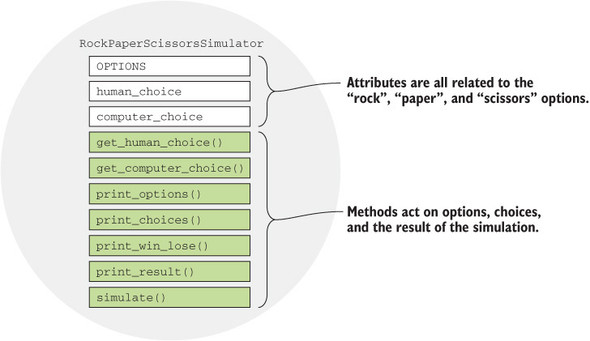
Listing 2.4. Moving functions into a class as methods
import random

OPTIONS = ['rock', 'paper', 'scissors']


class RockPaperScissorsSimulator:
    def get_computer_choice(self):                               #1
        return random.choice(OPTIONS)

    def get_human_choice(self):
        choice_number = int(input('Enter the number of your choice: '))
        return OPTIONS[choice_number - 1]

    def print_options(self):
        print('\n'.join(f'({i}) {option.title()}' for i,
 option in enumerate(OPTIONS)))

    def print_choices(self, human_choice, computer_choice):      #2
        print(f'You chose {human_choice}')
        print(f'The computer chose {computer_choice}')

    def print_win_lose(self, human_choice, computer_choice,
 human_beats, human_loses_to):
        if computer_choice == human_loses_to:
            print(f'Sorry, {computer_choice} beats {human_choice}')
        elif computer_choice == human_beats:
            print(f'Yes, {human_choice} beats {computer_choice}!')

    def print_result(self, human_choice, computer_choice):
        if human_choice == computer_choice:
            print('Draw!')

       if human_choice == 'rock':
           self.print_win_lose('rock', computer_choice, 'scissors', 'paper')
        elif human_choice == 'paper':
           self.print_win_lose('paper', computer_choice, 'rock', 'scissors')
        elif human_choice == 'scissors':
           self.print_win_lose('scissors', computer_choice, 'paper', 'rock')
Classes can grow unruly like functions, and perhaps at a faster rate. But it feels somehow more scary to break down a class than it does a function. Functions feel like building blocks, but classes feel like completed products. This is a mental barrier I often struggle to suppress.
You should have the confidence to decompose classes as frequently as functions. Classes are just another tool at your disposal. When you find that a class starts growing in complexity, it’s usually due to a mixing of concerns. Once you identify a concern that feels like its own object, you’ve got enough to start breaking it down.
When you extracted get_format_function from random_food in section 9.2.2, you still called the extracted function from its original location. When dealing with classes, something similar will need to happen if you want to maintain backward compatibility. Backward compatibility is the practice of evolving your software without breaking the implementation consumers previously relied on. If you change the arguments of a function, the name of a class, and so on, consumers will need to update their code if they want it to continue working. To avoid these problems, you could take a hint from the post office’s mail forwarding system.
This is an excerpt from Manning's book Mastering Large Datasets with Python: Parallelize and Distribute Your Python Code.
We will cover some advanced topics in this book as we work up to dealing with large datasets. That said, in the first section of this book (chapters 1 through 6), one of my goals is to provide all my readers with background knowledge that may be missing from their programming education. Depending on your experience, you may already be familiar with some of the concepts, such as regular expressions, classes and methods, higher order functions, and anonymous functions. If not, you will be by the end of chapter 6.
Figure 4.6. We can use a class containing a regular expression to transform a poem into a list of words.
![]()
Ultimately, we should end up with a class that looks like the following listing. In the listing, I’ve chosen to remove all periods, commas, semicolons, colons, exclamation points, question marks, and hyphens with the regular expression.
For simulation problems like this, it’s often useful to program in a slightly different way than we’ve been programming up to now. For simulations, we get a lot of value from writing classes, which we haven’t talked about much outside of a way to compile regular expressions. Classes are great because they allow us to consolidate the data about each piece of the simulation (figure 4.9). In this specific simulation, we have two actors that need special attention and deserve their own class:
Those two methods, .go_fishing and .update, round out our Village class. We’ll use that class to represent villages in our simulation (figure 4.11). Additionally, as mentioned earlier, we’ll need a class for the simulation itself. This class will keep track of the simulation-level variables, such as what year it is and how many fish remain. Additionally, our simulation class will have a rather large method for running the simulation itself.
This is an excerpt from Manning's book Natural Language Processing in Action: Understanding, analyzing, and generating text with Python.
Most (if not all) programming languages are drawn from the class of context-free languages.
The code in listing 5.3 solved the OR problem with a single perceptron. The table of 1s and 0s in listing 5.1 that our perceptron learned was the output of binary OR logic. The XOR problem slightly alters that table to try to teach the perceptron how to mimic an Exclusive OR logic gate. If you changed the correct answer for the last example from a 1 (True) to a 0 (False) to represent XOR logic, that makes the problem a lot harder. The examples in each class (0 or 1) aren’t linearly separable without adding an additional neuron to our neural network. The classes are diagonal from each other in our two-dimensional feature vector space (similar to figure 5.5), so there’s no line you can draw that separates 1s (logic Trues) from 0s (logic Falses).
This is an excerpt from Manning's book Get Programming: Learn to code with Python.
class Queue(object):
    def __init__(self):
        self.queue = []
    def get_queue_elements(self):
        return self.queue.copy()
    def add_one(self, item):
        self.queue.append(item)
    def add_many(self, item, n):
        for i in range(n):
            self.queue.append(item)
    def remove_one(self):
        self.queue.pop(0)
    def remove_many(self, n):
        for i in range(n):
            self.queue.pop(0)
    def size(self):
        return len(self.queue)
    def prettyprint(self):
        for thing in self.queue[::-1]:
            print('|_',thing, '_|')

# testing the class by making objects and doing operations
a = Queue()
a.add_one(3)
a.add_one(1)
a.prettyprint()
a.add_many(6,2)
a.prettyprint()
a.remove_one()
a.prettyprint()
b = Queue()
b.prettyprint()
Define data properties for a class Define operations for a class Use a class to create objects of that type and perform operations
The first part of creating your own object type is to define the class. You use the class keyword to do this. A simple object type you may want to create is an object representing a circle. You tell Python that you want to define a new object type through a class. Consider the following line:
class Circle(object):The keyword class starts the definition. The word Circle is the name of your class as well as the name of the object type that you want to define. In the parentheses, the word object means that your class is going to be a Python object. All classes you define are going to be Python objects. As such, objects created using your class will inherit all basic behaviors and functionality that any Python object has—for example, binding a variable to your object by using the assignment operator.
In this lesson, my objective was to teach you how to define a class in Python. Here are the major takeaways:
A class defines an object type. A class defines data attributes (properties) and methods (operations).


This is an excerpt from Manning's book Hello! Python.
Functions are one of the main units of encapsulation in Python. Even advanced structures such as classes, which we cover in chapter 6, are composed of functions. Python also has what are called first-class functions, which means that you can assign functions to variables and pass them to other functions. You’ll learn more about how to use functions like this in chapter 7.
If you think all the way back to chapter 2, you might remember that you had a group of functions that dealt with caves for the player and wumpus to live in. There was a function for creating a cave, another for linking two caves together to create a tunnel, one to make sure all the caves were linked, and so on. When you were writing the program, you dealt with the caves entirely through functions. One way to create a class is to identify a group of functions like this and make their relationship official.
Think of classes as a big rubber stamp. Once you’ve created your rubber stamp, you can easily stamp out as many pictures as you like. Classes work the same way. You generally don’t work directly with a class: you instead work with instances of that class, which you create by using the original class.
Classes in a program have one advantage—if you need a slightly different picture, it’s easy to create a copy of the original class, change it a bit, and work with that. Figure 6.1 shows you what the classes in this chapter might look like, if they were rubber stamps.
Both the instance and the class itself can have methods for you to call and data to access. For the most part, these will be set when you first create an instance, but Python also allows you to update them on the fly if you need to, even to the point of rebinding methods.