concept each element in category python

appears as: each element
Tiny Python Projects: Learn coding and testing with puzzles and games

This is an excerpt from Manning's book Tiny Python Projects: Learn coding and testing with puzzles and games.
We can write the list comprehension with the add1() code in line:

>>> [n + 1 for n in [1, 2, 3]]
[2, 3, 4]

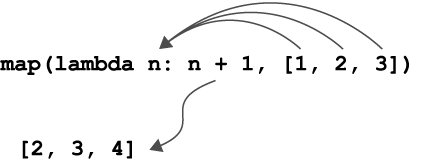
That looks very similar to the lambda code (as illustrated in figure 8.8):

>>> list(map(lambda n: n + 1, [1, 2, 3]))
[2, 3, 4]

Here is how we could use map():

Figure 8.8 The map() function will create a new list from processing each element of an iterable through a given function.

Figure 8.9 map() will apply a given function to each element of an iterable. A string will be processed as a list of characters.

The enumerate() function returns a list of tuples that include the index and value of each element in a list (see figure 21.4). Since it’s a lazy function, I must use the list() function in the REPL to view the values:

Python Workout: 50 ten-minute exercises

This is an excerpt from Manning's book Python Workout: 50 ten-minute exercises.

The splat operator is especially useful when you want to receive an unknown number of arguments. Typically, you’ll expect that all of the arguments will be of the same type, although Python doesn’t enforce such a rule. In my experience, you’ll then take the tuple (numbers, in this case) and iterate over each element with either a for loop or a list comprehension.

You can think of this implementation of mysum as the same as our original version, except that instead of adding each element to 0, we’re adding each one to items[0].