concept force in category python
This is an excerpt from Manning's book Math for Programmers: 3D graphics, machine learning, and simulations with Python.
As any experienced action gamer will tell you, you need to aim slightly above the helicopter to hit it! To simulate physics, you have to know how forces affect objects and cause continuous change over time. The math of continuous change is called calculus, and the laws of physics are usually expressed in terms of objects from calculus called differential equations. You learn how to animate 3D objects in chapters 4 and 5, and then how to simulate physics using ideas from calculus in part 2.
Figure 11.6: The black hole in our asteroid game is a black circle with every object in the game feeling the pull of a force toward it.
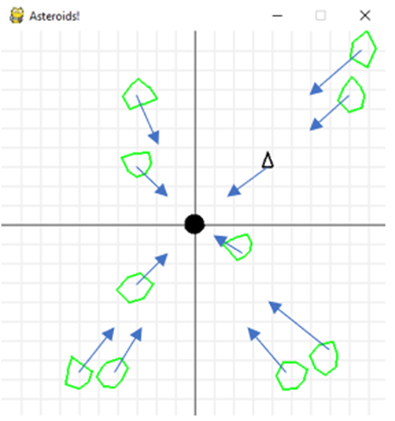
To make this work, we implement a BlackHole class, define its corresponding gravitational field as a function and then update our game loop so that the spaceship and asteroids respond to the forces according to Newton’s laws.
If this vector field works like a gravitational field, it tells us the force per unit mass on an object at position (x, y). In other words, the force on an object of mass m will be F(x, y) = m * g(x, y). If this is the only force our object feels, we can figure out its acceleration using Newton’s second law of motion: