concept motion in category python
This is an excerpt from Manning's book Math for Programmers: 3D graphics, machine learning, and simulations with Python.
To implement motion in the asteroid game, we’ll use many of the same calculus concepts from chapter 8. The numerical quantities we’ll consider are the x and the y positions of the asteroids and of the spaceship. If we want the asteroids to move, these values are different at different points in time, so we can consider them to be functions of time: x(t) and y(t). The derivative of a position function with respect to time is called velocity, and the derivative of velocity with respect to time is called acceleration. Because we have two position functions, we have two velocity functions and two acceleration functions. This allows us to think of velocities and accelerations as vectors as well.
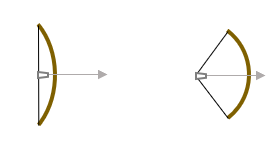
After modeling the gravitational field, we’ll look at a second, equivalent mental model for force at a distance, called potential energy. You can think of potential energy as stored energy, ready to be converted into motion. For instance, a bow and arrow have no potential energy to begin with, but when you stretch the bow it gains potential energy. When the bow is released, this energy is converted into motion (figure 11.3).
Figure 11.3: On the left, the bow has no potential energy. On the right, it has a lot of potential energy, ready to be spent to put the arrow in motion.