concept True in category python

This is an excerpt from Manning's book Tiny Python Projects: Learn coding and testing with puzzles and games.
Flags --A Boolean value like “yes”/“no” or True/Falseis indicated by something that starts off looking like a named option, but there is no value after the name; for example, the-dor--debugflag to turn on debugging. Typically the presence of the flag indicates aTruevalue for the argument, and its absence would meanFalse, so--debugturns on debugging, whereas its absence means it is off.
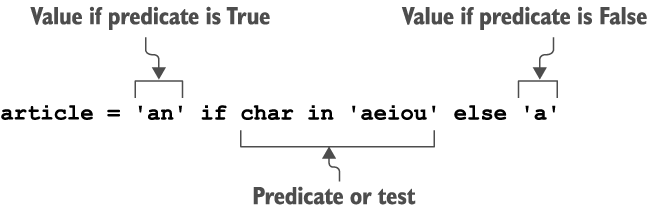

This is an excerpt from Manning's book Python Workout: 50 ten-minute exercises.
Now that the computer has chosen a number, it’s the user’s turn to guess what that number is. Here, we start an infinite loop in Python, which is most easily created with
whileTrue. Of course, it’s important that there be a way to break out of the loop; in this case, it will be when the user correctly guesses the value ofanswer. When that happens, thebreakcommand is used to exit from the innermost loop.
Table 4.1 What you need to know (view table figure)


This is an excerpt from Manning's book Get Programming: Learn to code with Python.
Write a function named common. It takes in two parameters, lists named L1 and L2. The function doesn’t mutate L1 or L2. It returns True if every unique element in L1 is in L2 and if every unique element in L2 is in L1. It returns False otherwise. Hint: try to reuse your function from Q25.2. For example,
common([1,2,3], [3,1,2]) returns True common([1,1,1], [1]) returns True