concept Deutsch in category quantum computing
This is an excerpt from Manning's book Learn Quantum Computing with Python and Q#.
In the next chapter, we’ll build on these skills by going back to Camelot to find our first example of a quantum algorithm, the Deutsch–Jozsa algorithm.
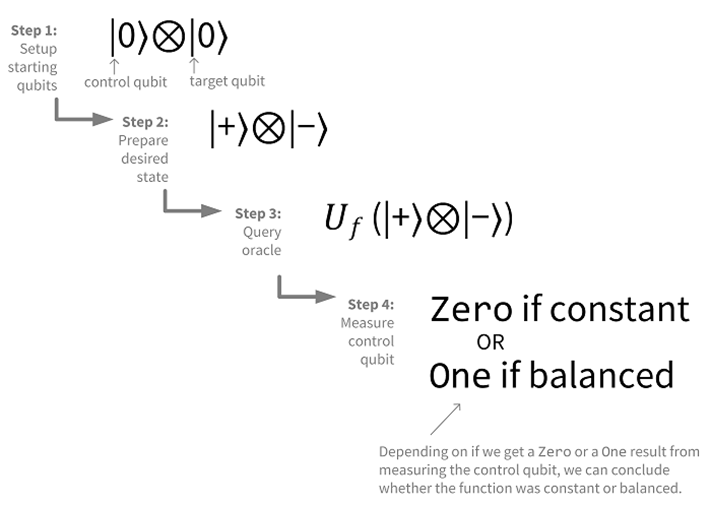
One important application for quantum algorithms is in obtaining speedups for solving problems where we need to search over inputs to a function that we’re trying to learn about. Such functions could be obfuscated (such as hash functions), or could be computationally difficult to evaluate (common in studying mathematical problems). In either case, applying quantum computers to such problems requires us to understand how we program and provide input to quantum algorithms. To learn how to do so, we’ll program up and run an implementation of an algorithm known as the Deutsch–Jozsa algorithm, which will let us learn properties of unknown functions quickly using quantum devices.
Figure 7.11. Steps to the Deutsch–Jozsa Algorithm.
We’ll see an example in Chapter 10 where we can use techniques such as those developed in the Deutsch–Jozsa algorithm to more quickly ask questions about such functions.
With these oracles now implemented in Q#, we can write the entirety of the Deutsch–Jozsa algorithm (as well Nimue’s strategy for Kingmaker)!
Figure 7.12. Steps to the Deutsch–Jozsa Algorithm.

Listing 7.4. Algorithm.qs: Q# operation implementing the Deutsch–Jozsa algorithm
operation CheckIfOracleIsBalanced(
        oracle : ((Qubit, Qubit) => Unit)
) : Bool {
    using ((control, target) = (Qubit(), Qubit())) {    #1
H(control); #2
        X(target);
        H(target);

        oracle(control, target);                        #3

        H(target);                                      #4
        X(target);

        return MResetX(control) == One;                 #5
    }
}