concept ground state energy in category quantum computing
This is an excerpt from Manning's book Learn Quantum Computing with Python and Q#.
Quantum computers also offer significant benefits to simulating properties of quantum systems, opening up applications to quantum chemistry and materials science. For instance, quantum computers could make it much easier to learn about the ground state energies of chemical systems. These ground state energies then provide insight into reaction rates, electronic configurations, thermodynamic properties, and other properties of immense interest in chemistry.
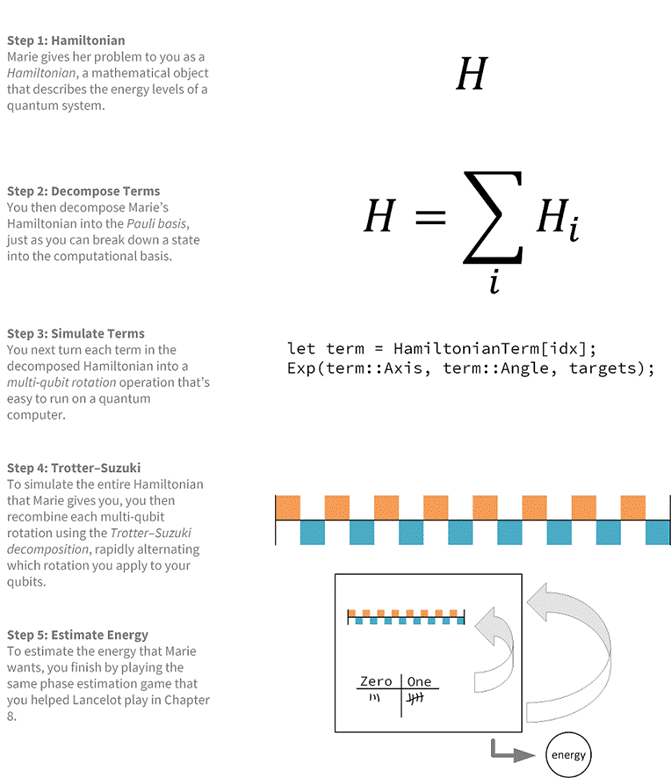
Figure 9.2. Overview of the steps you will develop in this chapter to help Marie learn the ground state energy of her molecule.
Listing 9.1. Final Q# operation that can estimate the ground state energy of the H₂ molecule.
operation EstimateH2Energy(idxBondLength : Int) : Double {
    let nQubits = 2;
    let trotterStepSize = 1.0;
    let trotterStep = EvolveUnderHamiltonian(idxBondLength, trotterStepSize, _);
    let estPhase = EstimateEnergy(nQubits,
                                    PrepareInitalState,
                                    trotterStep,
                                    RobustPhaseEstimation(6, _, _));
    return estPhase / trotterStepSize + H2IdentityCoeff(idxBondLength);
}
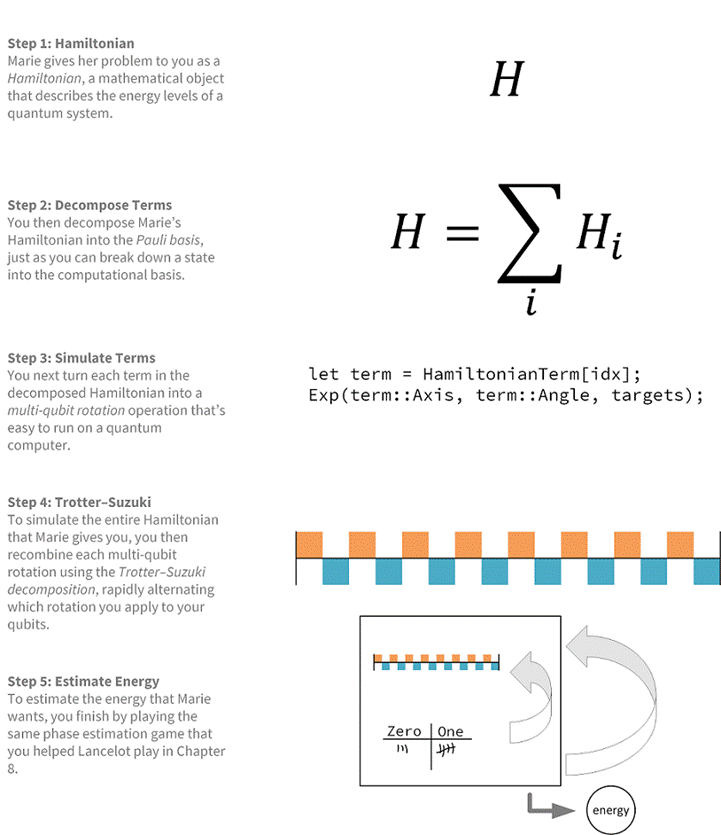
Figure 9.9. Overview of the steps you will develop in this chapter to help Marie learn the ground state energy of her molecule.
So, you being a quantum developer, can collaborate with Marie to simulate the evolution of the H₂ molecule in time and calculate what the ground state energy is thanks to Schrödinger’s equation. The key point to remember is that the energy levels that the H₂ molecule can be is correspond to the different eigenstates of the Hamiltonian.