concept word in category R

This is an excerpt from Manning's book Deep Learning with R.
A dataset of text documents, where we represent each document by the counts of how many times each word appears in it (out of a dictionary of 20,000 common words). Each document can be encoded as a vector of 20,000 values (one count per word in the dictionary), and thus an entire dataset of 500 documents can be stored in a tensor of shape (500, 20000).
This chapter explores deep-learning models that can process text (understood as sequences of words or sequences of characters), timeseries, and sequence data in general. The two fundamental deep-learning algorithms for sequence processing are recurrent neural networks and 1D convnets, the one-dimensional version of the 2D convnets that we covered in the previous chapters. We’ll discuss both of these approaches in this chapter.
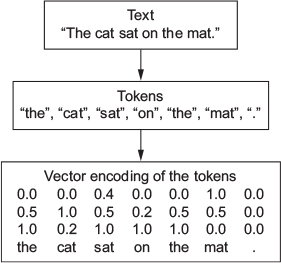
Extract n-grams of words or characters, and transform each n-gram into a vector. N-grams are overlapping groups of multiple consecutive words or characters. Collectively, the different units into which you can break down text (words, characters, or n-grams) are called tokens, and breaking text into such tokens is called tokenization. All text-vectorization processes consist of applying some tokenization scheme and then associating numeric vectors with the generated tokens. These vectors, packed into sequence tensors, are fed into deep neural networks. There are multiple ways to associate a vector with a token. In this section, We’ll present two major ones: one-hot encoding of tokens, and token embedding (typically used exclusively for words, and called word embedding). The remainder of this section explains these techniques and shows how to use them to go from raw text to a tensor that you can send to a Keras network.
Understanding n-grams and bag-of-words
Word n-grams are groups of N (or fewer) consecutive words that you can extract from a sentence. The same concept may also be applied to characters instead of words.
Let’s parse the unzipped file (a .txt file) to build an index that maps words (as strings) to their vector representation (as number vectors).
Listing 6.10. Parsing the GloVe word-embeddings file
glove_dir = "~/Downloads/glove.6B" lines <- readLines(file.path(glove_dir, "glove.6B.100d.txt")) embeddings_index <- new.env(hash = TRUE, parent = emptyenv()) for (i in 1:length(lines)) { line <- lines[[i]] values <- strsplit(line, " ")[[1]] word <- values[[1]] embeddings_index[[word]] <- as.double(values[-1]) } cat("Found", length(embeddings_index), "word vectors.\n")Next, you’ll build an embedding matrix that you can load into an embedding layer. It must be a matrix of shape (max_words, embedding_dim), where each entry i contains the embedding_dim-dimensional vector for the word of index i in the reference word index (built during tokenization). Note that index 1 isn’t supposed to stand for any word or token—it’s a placeholder.
One-hot encoding is the most common, most basic way to turn a token into a vector. You saw it in action in the initial IMDB and Reuters examples in chapter 3 (done with words, in that case). It consists of associating a unique integer index with every word and then turning this integer index i into a binary vector of size N (the size of the vocabulary); the vector is all zeros except for the i th entry, which is 1.
Of course, one-hot encoding can be done at the character level, as well. To unambiguously drive home what one-hot encoding is and how to implement it, listings 6.1 and 6.2 show two toy examples: one for words, the other for characters.