concept client in category redis

This is an excerpt from Manning's book Redis in Action.
Even though Redis is able to perform well, due to its in-memory design there are situations where you may need Redis to process more read queries than a single Redis server can handle. To support higher rates of read performance (along with handling failover if the server that Redis is running on crashes), Redis supports master/slave replication where slaves connect to the master and receive an initial copy of the full database. As writes are performed on the master, they’re sent to all connected slaves for updating the slave datasets in real time. With continuously updated data on the slaves, clients can then connect to any slave for reads instead of making requests to the master. We’ll discuss Redis slaves more thoroughly in chapter 4.
As people perform a variety of actions within our social network, those actions are seen at the various functions that defined our API. In particular, we spent most of our time building out the ability to follow/unfollow users, and post/delete messages. If we’d built other pieces of our social network, we’d also find a variety of other events that occur as the result of user behavior. A streaming API is meant to produce a sequence of these events over time as a way of keeping clients or other services updated about a subset of what’s going on across the entire network.
In preceding sections and chapters, when we showed functions that made calls to Redis, we built on the assumption that we had an existing web server that would be calling these functions at just the right time. In the case of a streaming API, the details of streaming data to a client can be more complicated than just plugging these functions into an existing web service stack. In particular, most web servers operate under the assumption that we’ll be returning the entire response to a request at once, but this is definitely not the case with a streaming API.
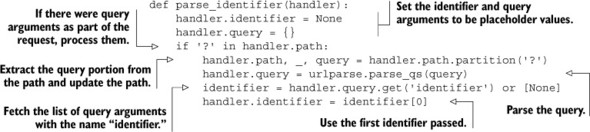
The first of these two functions is a way of fetching identifying information about the client. This basic method extracts an identifier from the request query arguments. For a production scenario, we’d want to perform some amount of client validation of the identifier. Our simple method to parse an identifier from the request can be seen in the next listing.