concept DQN in category reinforcement learning

This is an excerpt from Manning's book Grokking Deep Reinforcement Learning.
There were other successes in the 2000s, but the field of DRL really only started growing after the DL field took off around 2010. In 2013 and 2015, Mnih et al. published a couple of papers presenting the DQN algorithm. DQN learned to play ATARI games from raw pixels. Using a convolutional neural network (CNN) and a single set of hyperparameters, DQN performed better than a professional human player in 22 out of 49 games.
In this section, we explore an algorithm called Deep Deterministic Policy Gradient (DDPG). DDPG can be seen as an approximate DQN, or better yet, a DQN for continuous action-spaces. DDPG uses many of the same techniques found in DQN: it uses a replay buffer to train an action-value function in an off-policy manner, and target networks to stabilize training. However, DDPG also trains a policy, which approximates the optimal action. Because of this, DDPG is a deterministic policy-gradient method restricted to continuous action spaces.
This is an excerpt from Manning's book Deep Reinforcement Learning in Action.
An off-policy reinforcement learning algorithm like Q-learning means that the choice of policy does not affect the ability to learn accurate Q values. Indeed, our Q-network could learn accurate Q values if we selected actions at random; eventually it would experience a number of winning and losing games and infer the values of states and actions. Of course, this is terribly inefficient, but the policy matters only insofar as it helps us learn with the least amount of data. In contrast, an on-policy algorithm will explicitly depend on the choice of policy or will directly aim at learning a policy from the data. In other words, in order to train our DQN, we need to collect data (experiences) from the environment, and we could do this using any policy, so DQN is off-policy. In contrast, an on-policy algorithm learns a policy while simultaneously using the same policy to collect experiences for training itself.
Most convincingly, an empirical study was done that evaluated several popular variants and improvements to the original DQN algorithm, including a distributional variant of DQN, to see which were most effective alone and which were most important in combination (“Rainbow: Combining Improvements in Deep Reinforcement Learning” by Hessel et al., 2017). It turns out that distributional Q-learning was the best-performing algorithm overall, among all the individual improvements to DQN that they tested. They combined all the techniques together in a “Rainbow” DQN, which was shown to be far more effective than any individual technique. They then tested to see which components were most crucial to the success of Rainbow, and the results were that distributional Q-learning, multistep Q-learning (covered in chapter 5), and prioritized replay (which will be briefly covered in section 7.7) were the most important to the Rainbow algorithm’s performance.
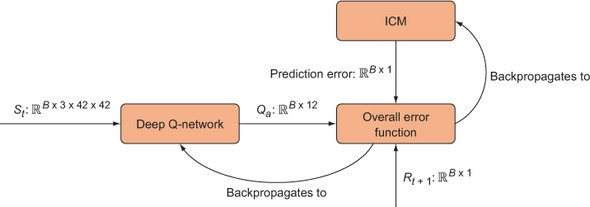
Figure 8.15. The DQN and the ICM contribute to a single overall loss function that is given to the optimizer to minimize with respect to the DQN and ICM parameters. The DQN’s Q-value predictions are compared to the observed rewards. The observed rewards, however, are summed together with the ICM’s prediction error to get a new reward value.