concept evaluative feedback in category reinforcement learning

This is an excerpt from Manning's book Grokking Deep Reinforcement Learning.
1.1.6 Deep reinforcement learning agents learn from evaluative feedback
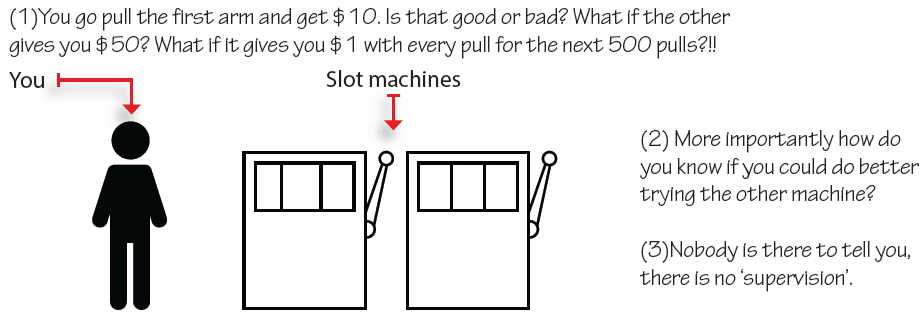
The reward received by the agent may be weak, in the sense that it may provide no supervision. The reward may indicate goodness and not correctness, meaning it may contain no information about other potential rewards. Thus the agent must be able to learn from evaluative feedback. Evaluative feedback gives rise to the need for exploration. The agent must be able to balance the gathering of information with the exploitation of current information. This is also referred to as the exploration vs. exploitation tradeoff.
Figure 1.10 The difficulty of the exploration vs. exploitation tradeoff
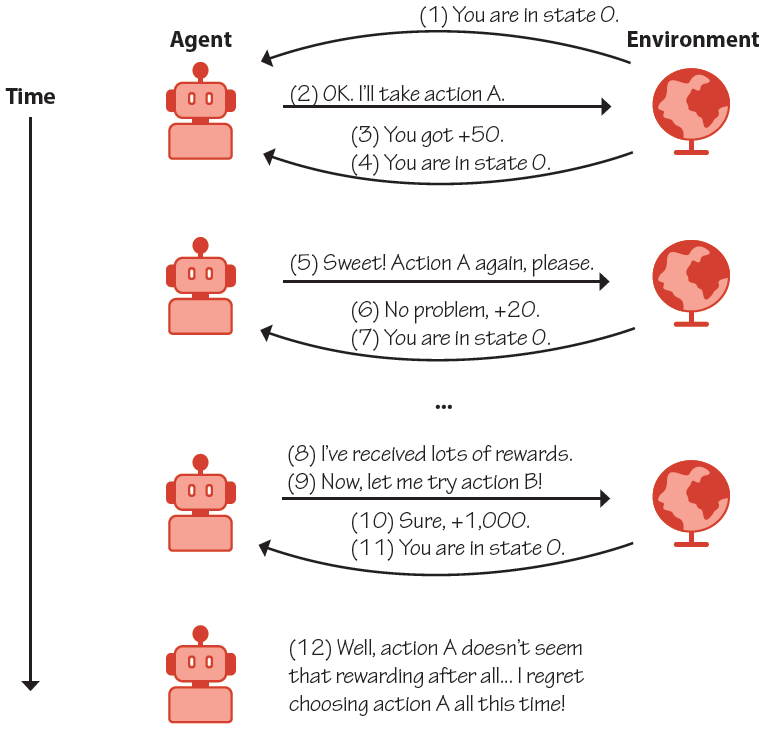
In chapter 4, we’ll study the ins and outs of evaluative feedback in isolation. That is, your programs will learn from feedback that is simultaneously one-shot (as opposed to sequential,) evaluative, and exhaustive (as opposed to sampled).
In the previous chapter, you learned about the challenges of learning from sequential feedback and how to properly balance immediate and long-term goals. In this chapter, we examine the challenges of learning from evaluative feedback, and we do so in environments that are not sequential, but one shot instead: Multi-Armed Bandits (MAB).
MABs isolate and expose the challenges of learning from evaluative feedback. We’ll dive into many different techniques for balancing exploration and exploitation in these particular type of environments: single-state environments with multiple options, but a single choice. Agents will operate under uncertainty, that is, they will not have access to the MDP. However, they will do so in one-shot environments, without the sequential component.
Remember, in DRL, agents learn from feedback that is simultaneously sequential (as opposed to one shot), evaluative (as opposed to supervised) and sampled (as opposed to exhaustive). In this chapter, I’m eliminating the complexity that comes along with learning from sequential and sampled feedback, and we’ll study the intricacies of evaluative feedback in isolation. Let’s get to it.
Figure 8.7 Bandits deal with evaluative feedback