concept Mocha in category ruby

This is an excerpt from Manning's book Ruby in Practice.
In this section, we’ll look at a couple of ways to create mock objects. The first method we’ll discuss is creating your own mock object patterns, no library required. We’ll then take a look at using libraries such as Mocha to create mock objects.
If you find that Mocha doesn’t work with your testing practices, or that it is “too magical,” you may want to look into FlexMock, Jim Weirich’s mocking library, or RSpec’s mocking capabilities.
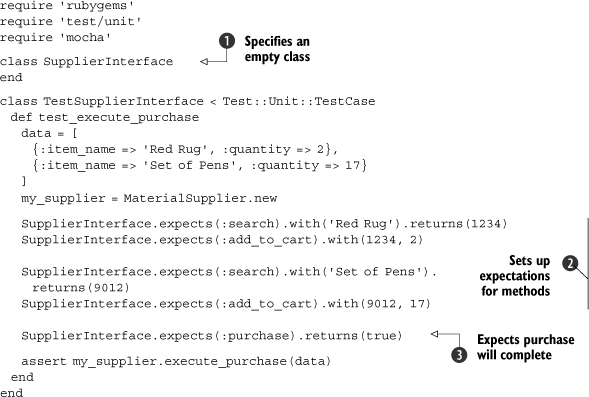
Mocha works via a mechanism it calls expectations (which is why we called our hash $expectations in the earlier examples). Mocha sets expectations on object behavior; so, for example, you might set an expectation that an object will have its process method called or that an object’s save method will be called and it should return true. This is just like what we did before, except that Mocha makes the process much cleaner. Mocha expectations are defined by a single method, expects, and they can be attached to any object. When an expectation is attached to an object, a stub is automatically created and an expectation is set up. Listing 2.17 shows our example (from listing 2.16) refactored to use Mocha.