concept cold observable in category rxjs

This is an excerpt from Manning's book RxJS in Action.
As you can see, RxJS provides a comprehensive set of error-handling operations that allows you to easily retry an entire observable sequence when an error is detected in the pipeline. But we made a huge assumption about the nature of the observable sequences. That is, the observables that we created and retried in this chapter belong to a category known as cold observables. Cold observables are passive (dormant) and emit values only when subscribed to: an array of numbers, a Promise, intervals, and the like. In other words, retrying a cold observable basically resubscribes to it and requests that it emit its values again. In the next chapter, you’ll learn to create and handle the different types of observables: cold and hot.
A TV’s live stream is equivalent to a hot observable. RxJS divides observable sources into either of two categories: hot or cold. These categories determine the behavioral characteristics, not just of subscription semantics, but also of the entire lifetime of the stream. An observable’s temperature also affects whether the stream and the producer are managed together or separately, which can greatly affect resource utilization (we’ll get to this shortly). We classify an observable as either hot or cold based on the nature of the data source that it’s listening to. Let’s begin with cold observables.
The resubscription mechanism of cold observables is easy to reason about because each stream carries its own copy of the producer, spawning a new pipeline back up to the source. This happens in RxJS by default when wrapping synchronous data sources like scalars and arrays but also through custom observables containing asynchronous data sources such as remote event emitters, AJAX calls, or WebSockets that are created within the observable context. In all these cases, you deal with cold observables. From a functional point of view, this is the purest solution because no data is being shared and the observable acts like a template (or a recipe, as we mentioned previously) for creating data, as shown in figure 8.10.
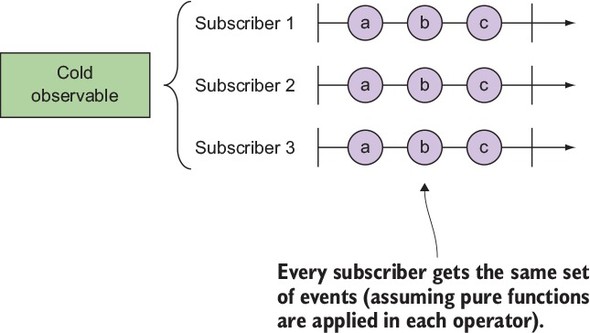
In simple terms, a cold observable is one that doesn’t begin emitting all of its values until an observer subscribes to it. Cold observables are typically used to wrap bounded data types such as numbers, ranges of numbers, strings, arrays, and HTTP requests, as well as unbounded types like generator functions. These resources are known as passive in the sense that their declaration is independent of their execution. This also means that these observables are truly lazy in their creation and execution.
Now, this isn’t news to you, because that’s what we’ve defined an observable to be all along, so what’s the catch? Being cold means that each new subscription is creating a new independent stream with a new starting point for that stream. This means that subscribers will independently receive the exact same set of events always, from the beginning. Here’s another way to conceptualize it: when creating a cold observable, you’re actually creating a plan or recipe to be executed later—repeatedly, top to bottom. The recipe itself is just a set of instructions (operators) that tell the JavaScript runtime engine how to combine and cook the ingredients (data); cold observables begin emitting events only when you choose to start cooking.