concept library in category rxjs

This is an excerpt from Manning's book RxJS in Action.
Although modern system architectures have improved dramatically to include faster network devices and highly concurrent processing, the libraries and methods for dealing with the added complexity of remote data haven’t made the same strides. For example, when it comes to fetching data from a server or running any deferred computation, most of us still rely on the use of callbacks, a pattern that quickly breaks down when business rules evolve and change or the problem we’re trying to solve involves data that lives not in one but in several different remote locations.
The solution lies not only in which library to use but which paradigm best suits these types of problems. In this book, you’ll first learn about the fundamental principles of two emerging paradigms: functional programming (FP) and reactive programming (RP). This exhilarating composition is what gives rise to functional reactive programming (FRP), encoded in a library called RxJS (or rx.js), which is the best prescription to deal with asynchronous and event-based data sources effectively.
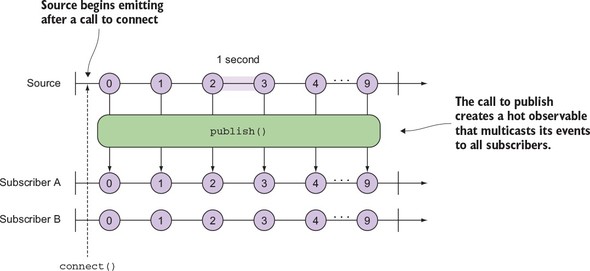
Figure 8.14. Publish creates a hot observable whereby all subscribers begin receiving the events as soon as the call to connect is made. Otherwise, the source stream behaves like a cold observable, sitting idle until connect() is called. The share() operator would yield the same results except that the call to connect() would be done internally by the library.
The Google client library unlocks the power to access all of Google’s web APIs, including the URL shortener used in chapter 9. The only requirement to use the library is to have an active Google account and to generate the OAuth2 token for that API, which you can do through the Google APIs console.